
Whole House Water Filtration: Types and Installation
Compare whole house water filtration system types and installation options, from sediment and carbon to softeners. Call (833)-365-8755 for expert guidance.

Learn more about Water Treatment System Installation or Replacement for guides, costs, and what to expect.
Compare Water Treatment System Installation or Replacement Pros Near You

Enter your ZIP code to compare top-rated local professionals and request free quotes.
Your water looks clear, but that faint chlorine smell, the white crust on your faucets, or the odd taste in your morning coffee tells a different story. You are not alone: millions of homeowners deal with hard water, sediment, or chemical residue every day, and a whole house water filtration system is the upgrade that fixes the problem at the source. Unlike a pitcher filter or a single faucet attachment, a whole house system treats every drop that enters your home, protecting your plumbing, appliances, and skin. But before you buy, you need to understand the different types, how they work, and what installation actually involves. This guide breaks down the options so you can choose with confidence and avoid costly mistakes.
Point-of-Entry vs. Point-of-Use: Where the System Sits
The first decision is placement. Point-of-use (POU) filters treat water at a single fixture, such as under the kitchen sink or at a refrigerator line. They are affordable and easy to install, but they leave the rest of your home unprotected. Point-of-entry (POE) systems, also called whole house systems, connect to the main water line where it enters your home. Every tap, shower, and appliance receives filtered water. For homeowners dealing with hard water, sediment, or chlorine throughout the house, POE is the only option that solves the problem comprehensively.
A whole house system typically combines multiple stages in one tank or a series of tanks. The main line is cut and plumbed into the system, and water flows through each stage before distributing to the house. This setup requires decent water pressure and enough space near the main shutoff valve, usually in a basement, garage, or utility closet. If you are unsure about your home's plumbing layout, a professional contractor can assess the main line and recommend the best configuration. For related system sizing guidance, see our article on the right size HVAC system for your home, since proper sizing principles apply to water treatment too.
Sediment, Carbon, and Reverse Osmosis Stages Explained
Whole house systems are built from stages, each targeting a specific contaminant. Understanding these stages helps you compare systems and avoid paying for filtration you do not need.
Sediment filtration is the first line of defense. A sediment filter, usually rated at 5 to 20 microns, traps sand, dirt, rust, and debris before they reach finer stages. This protects the rest of the system and your plumbing. Sediment filters are mechanical and inexpensive to replace, typically every 3 to 6 months depending on water quality.
Carbon filtration is the workhorse for taste and odor. Activated carbon adsorbs chlorine, chloramines, volatile organic compounds (VOCs), and many pesticides. Granular activated carbon (GAC) and carbon block are the two common forms; carbon block offers finer filtration and longer contact time. Carbon media usually lasts 6 to 12 months, though catalytic carbon is needed if your utility uses chloramines.
Reverse osmosis (RO) is a membrane-based process that removes dissolved solids, heavy metals, nitrates, and fluoride. Whole house RO systems are less common because they waste water and require a storage tank and pump to maintain pressure. More often, homeowners install a POE sediment and carbon system plus a POU reverse osmosis unit under the kitchen sink for drinking water. This hybrid approach delivers the best value: whole house protection plus ultra-pure drinking water.
Other stages you may encounter include water softeners (ion exchange to remove calcium and magnesium), UV purifiers (to kill bacteria and viruses), and KDF media (to remove heavy metals and control bacteria). A reputable contractor can test your water and recommend a stage combination that matches your specific issues.
Hard Water Signs That Point to a Softener Instead
Not every water problem calls for filtration. If you see white scale on faucets and showerheads, spots on glassware, or feel a filmy residue after washing, you likely have hard water. Hard water contains dissolved calcium and magnesium, which filtration does not remove. A water softener uses ion exchange to swap those minerals for sodium or potassium, preventing scale buildup in pipes, water heaters, and appliances.
Other hard water signs include dry, itchy skin after showering, faded laundry, and soap that refuses to lather. If your water tests high for hardness (above 7 grains per gallon), a softener is the right fix. Many whole house systems combine softening and filtration in a single cabinet, which saves space and simplifies maintenance. Before buying any system, ask for a water quality report from your utility or have a contractor perform an on-site test. This step prevents you from investing in the wrong technology.
Installation Requirements and What to Expect
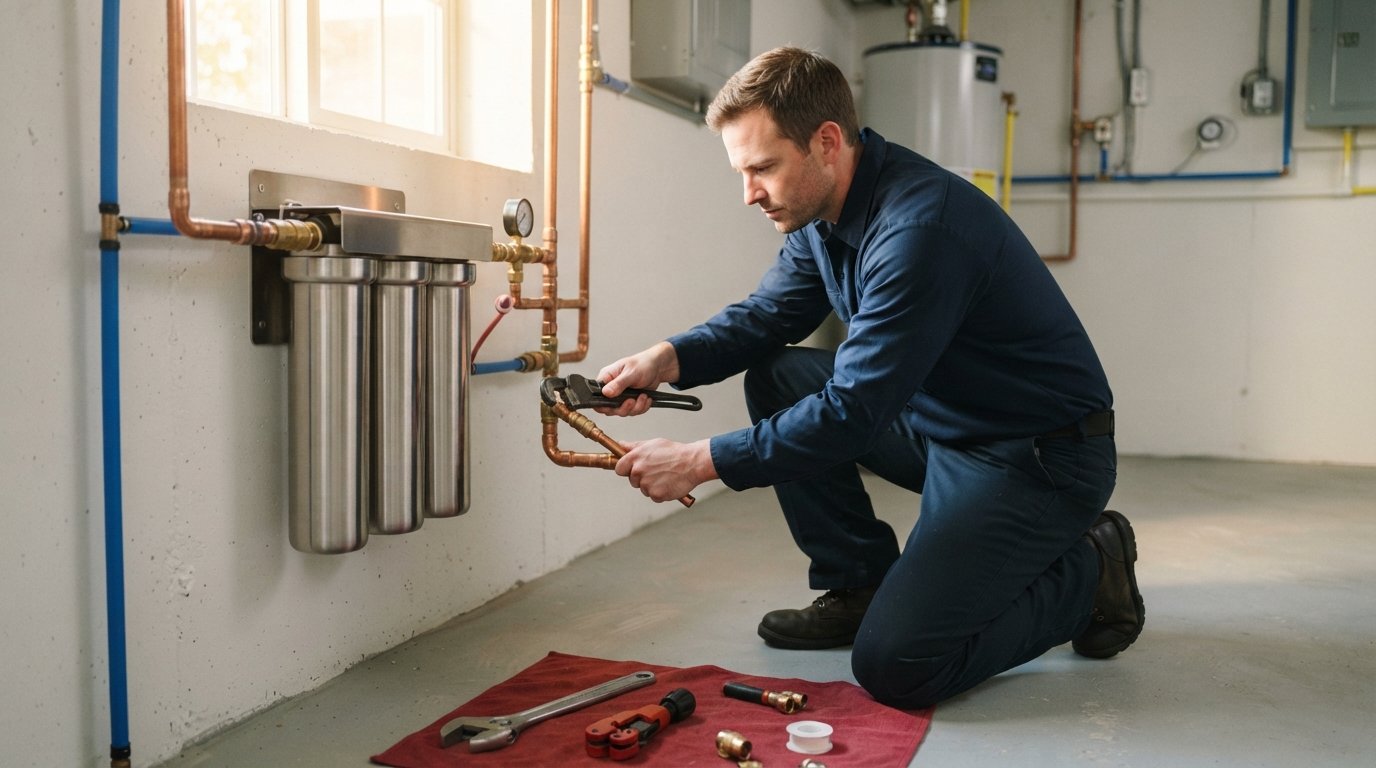
Installing a whole house filtration system is not a DIY weekend project for most homeowners. It involves cutting into the main water line, soldering or using push-fit connections, and ensuring proper drainage for backwash cycles. Here is what a typical installation involves:
- Water test and system sizing: A contractor tests hardness, chlorine, sediment, and flow rate to size the system correctly. Undersized systems restrict flow and wear out quickly.
- Location and clearance: The system needs a level, dry spot near the main line with enough clearance for filter changes and backwashing. A floor drain or sump is helpful for softeners and backwashing filters.
- Bypass valve installation: A three-valve bypass lets you isolate the system for maintenance without shutting off water to the house.
- Plumbing and electrical connections: Most systems need a power outlet for controllers or pumps. Some softeners require a drain line to discharge brine.
- Pressure and flow testing: After installation, the contractor checks for leaks and confirms that water pressure and flow rate meet household demand.
Installation typically takes 3 to 6 hours for a basic sediment and carbon system, and longer for systems with softeners or UV stages. Permits may be required in some municipalities, especially if you are modifying the main line. A licensed plumber or water treatment professional ensures the job is done to code and protects your warranty. If you are planning a larger home upgrade, you can connect with remodeling professionals who handle plumbing and water system integration as part of a broader project.
Maintenance Schedules and Long-Term Costs
Whole house systems are not install-and-forget. Filters and media need regular replacement to maintain performance. A typical maintenance schedule looks like this:
- Sediment filters: Replace every 3 to 6 months, or when pressure drops noticeably.
- Carbon filters: Replace every 6 to 12 months, depending on water usage and chlorine levels.
- Water softener resin: Lasts 10 to 15 years; salt needs refilling every 4 to 8 weeks.
- Reverse osmosis membranes: Replace every 2 to 3 years; pre-filters every 6 to 12 months.
- UV lamps: Replace annually for effective disinfection.
Budget for filter costs and occasional professional servicing. A basic sediment and carbon system costs $150 to $300 per year in filters, while a softener adds $100 to $200 annually in salt. These costs are far lower than repairing scale-damaged appliances or replacing a water heater prematurely. Regular maintenance also preserves water pressure and ensures the system continues to remove contaminants effectively.
Choosing the Right System for Your Home
Start with a water test, then match the system to your specific issues. If you have sediment and chlorine, a two-stage sediment and carbon system is sufficient. If hardness is high, add a softener. If you are concerned about drinking water purity, add a POU reverse osmosis unit under the kitchen sink. Consider your household size and peak water demand: a family of four with multiple bathrooms needs a system rated for at least 10 to 15 gallons per minute to avoid pressure drops during simultaneous showers and laundry.
Also think about space and future maintenance. Softeners and backwashing filters need drain access and periodic salt or media replacement. Cartridge-based systems are compact and easy to service but have higher filter costs over time. A professional assessment helps you balance upfront cost, maintenance, and performance. Many homeowners find that a mid-range system with quality components outperforms a cheap big-box unit that fails within a few years.
Finally, verify certifications. Look for NSF/ANSI 42 (aesthetic effects like chlorine and sediment) and NSF/ANSI 53 (health effects like lead and VOCs) ratings. These certifications confirm the system performs as claimed. A contractor who specializes in water treatment can guide you toward certified products and proper installation, so you get clean, safe water from every tap without guesswork.
Upgrading your water treatment is an investment in your home's plumbing, appliances, and your family's comfort. With the right system and professional installation, you can enjoy better-tasting water, fewer repairs, and peace of mind for years to come.