
Bifacial Solar Panels for Home Energy Output: Real Gains
Bifacial solar panels for home energy output can boost production when installed right. Call (833)-365-8755 to compare local installer quotes.

By Alex Carter
Learn more about Solar Panel Installation and Repair for guides, costs, and what to expect.
Compare Solar Panel Installation and Repair Pros Near You

Enter your ZIP code to compare top-rated local professionals and request free quotes.
Homeowners shopping for solar in 2026 face a crowded field of panel technologies, and bifacial modules have moved from utility-scale farms to residential rooftops and backyards. The promise sounds straightforward: generate power from both the front and back of the panel, capture reflected light, and squeeze more kilowatt-hours from the same footprint. The reality is more nuanced, because bifacial gains depend heavily on how and where the array is installed. This guide breaks down what bifacial panels actually deliver for home energy output, where they make financial sense, and how to evaluate installer proposals without getting lost in marketing claims.
How Bifacial Panels Capture Reflected Light
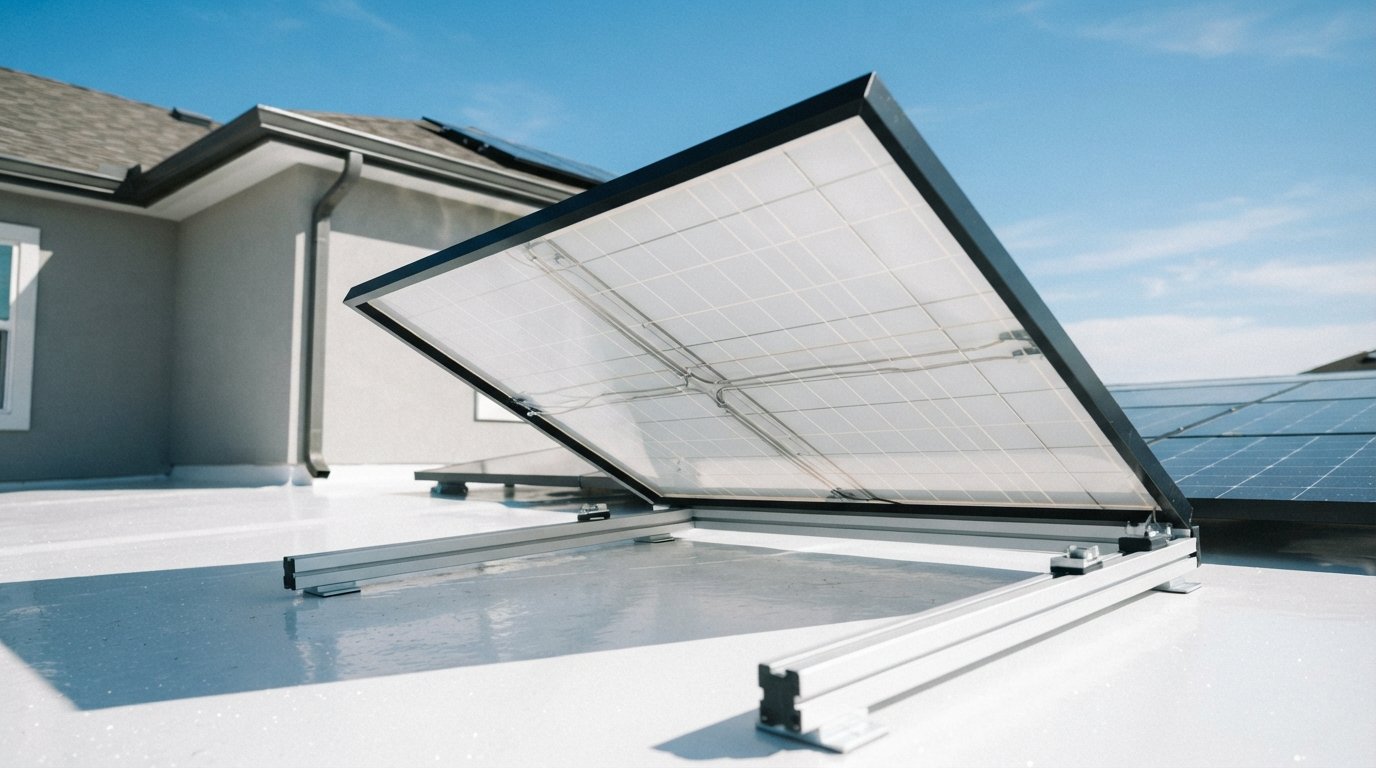
A standard monofacial solar panel absorbs sunlight on its front face and ignores whatever hits the back. A bifacial module replaces the opaque backsheet with a transparent or semi-transparent layer, allowing light that reflects off the ground, roof surface, or surrounding structures to reach the rear solar cells. Those rear cells contribute additional current, and the combined output can exceed what a monofacial panel of the same nameplate rating would produce under identical front-side irradiance.
The gain is usually expressed as a bifaciality factor, which is the ratio of rear-side efficiency to front-side efficiency. Most residential bifacial modules today fall in the 70 to 90 percent bifaciality range, meaning the back side can produce 70 to 90 percent of what the front produces when both receive equal light. In practice, the rear face rarely receives equal light, so real-world gains are smaller. The amount of reflected light available, called albedo, determines everything. A dark asphalt shingle roof has low albedo, while a white membrane roof, light gravel, snow, or a concrete patio has much higher albedo.
Understanding this mechanism matters because it explains why two homeowners can buy the same bifacial panel and see wildly different results. One installs over a dark shingle roof with minimal clearance, and the rear face contributes almost nothing. Another mounts the array on a light-colored ground surface with open space behind the modules, and the rear face adds meaningful production. The panel is only half the equation; the installation environment is the other half.
Where Bifacial Panels Produce the Most Gain
The highest residential bifacial gains tend to appear in ground-mounted arrays, carports, pergolas, and elevated structures where air and reflected light can reach the back of the module. Ground mounts with a light gravel base, white stone, or concrete pad can push rear-side contribution into the 8 to 15 percent range, and occasionally higher in snowy climates where snow cover boosts albedo dramatically. Elevated mounts that allow light to bounce underneath the array perform better than flush-mounted systems that trap the rear face against a dark surface.
Roof-mounted systems are a mixed bag. A flush-mounted bifacial array on a dark asphalt shingle roof typically captures very little reflected light, and the extra cost of the bifacial module may never pay back. However, a tilted rooftop array on a white TPO or PVC membrane roof, or a ground-mounted array in a backyard with light landscaping, can capture enough rear-side irradiance to justify the upgrade. Homeowners with flat roofs and reflective coatings are often the best candidates for rooftop bifacial systems.
The geographic and seasonal context also matters. Homes in sunny regions with high direct irradiance see strong front-side production regardless of panel type, so the bifacial bonus is incremental. Homes in snowy regions can see dramatic winter rear-side gains because snow reflects a large share of incoming light. The key takeaway is that bifacial panels are not universally better; they are conditionally better, and the conditions are predictable before installation.
Ground Mount Versus Roof Mount Suitability
Ground-mounted bifacial arrays offer the most design flexibility. Installers can set the tilt angle, choose the mounting height, and specify the ground cover to maximize rear-side irradiance. A raised ground mount with 3 to 4 feet of clearance above a light-colored surface is close to ideal. Homeowners with available yard space, especially in rural or suburban properties, should seriously consider ground mount as the default option for bifacial modules.
Roof-mounted bifacial arrays require more careful evaluation. Flush-mount systems on pitched roofs leave little room for rear-side light, and the roof surface color strongly influences results. Tilted roof mounts with a gap between the panel and the roof deck perform better, but the improvement is modest on dark shingles. Homeowners with flat roofs, white membranes, or reflective coatings have a stronger case. In all cases, the installer should model rear-side irradiance rather than simply assuming a standard gain.
Structural and code considerations also differ. Ground mounts require permitting for the structure, potential trenching for conduit, and setback compliance. Roof mounts must respect fire setbacks, wind uplift requirements, and roof load limits. Bifacial modules are slightly heavier than comparable monofacial panels because of the glass-on-glass construction, so roof-mounted systems need a structural check. None of these issues are deal-breakers, but they affect cost and timeline.
Efficiency Gain Expectations and Payback Timeline
Realistic residential bifacial gain expectations range from near zero on a dark, flush-mounted shingle roof to 10 to 20 percent on a well-designed ground mount with high albedo. The panel itself may carry a bifaciality factor of 80 percent, but the installation environment determines how much of that potential is realized. Homeowners should ask installers for modeled rear-side production, not just a nameplate bifaciality number.
Payback timeline depends on the incremental cost of bifacial modules versus monofacial equivalents and the value of the additional production. Bifacial modules often cost 5 to 15 percent more per watt than comparable monofacial panels, though the gap has narrowed as manufacturing scales. If the installation captures a 10 percent production bonus, the incremental payback can be reasonable, especially when paired with net metering or time-of-use rates that value midday production. If the installation captures only 2 percent, the upgrade may never pay back before the warranty ends.
Homeowners should also factor in inverter clipping and system sizing. A bifacial array that produces more than expected can clip at the inverter, wasting potential gains. Installers should size the inverter and DC-to-AC ratio with the bifacial bonus in mind, or specify a inverter with a higher input limit. The payback math is sensitive to these details, so a proposal that ignores them is incomplete.
Inverter and Racking Considerations for Bifacial Arrays
Bifacial modules interact with balance-of-system components in ways that monofacial modules do not. The most important consideration is inverter sizing. Because bifacial arrays can exceed their nameplate DC rating under high albedo and cool temperatures, the inverter should be sized to handle the expected peak without excessive clipping. Some installers deliberately oversize the DC array relative to the inverter to maximize energy harvest, but bifacial arrays push that ratio higher. A qualified installer will model the array's expected production profile and choose an inverter that balances clipping losses against cost.
Racking choice matters for rear-side irradiance. Open-rail racking that elevates modules above the mounting surface allows more reflected light to reach the back. Flush-mount racking minimizes rear clearance and reduces bifacial gain. Ground-mount racking should be set at a height that clears vegetation and allows light to bounce off the ground cover. Some racking systems are specifically designed for bifacial modules with optimized rail placement that minimizes shading of the rear face.
Monitoring and rapid shutdown requirements also deserve attention. Bifacial arrays may produce more variable output than monofacial arrays because rear-side irradiance changes with ground cover, snow, and nearby reflective surfaces. Module-level monitoring can help homeowners identify underperforming panels. Rapid shutdown compliance is required by code in most jurisdictions, and the added electronics should be compatible with the bifacial module's electrical characteristics. These details are not glamorous, but they determine whether the system performs as modeled.
Solar Quote Checklist: Comparing Installer Proposals
Comparing solar quotes is the most important step in the buying process, and bifacial systems require a few extra questions. A credible proposal should include modeled production, not just a nameplate wattage. It should specify the module model and bifaciality factor, the inverter model and DC-to-AC ratio, the racking type and mounting height, and the assumed albedo of the installation surface. If any of these are missing, the homeowner cannot evaluate whether the bifacial upgrade makes sense.
Use this checklist when reviewing proposals:
- Does the proposal include a rear-side irradiance model or albedo assumption for the specific installation surface?
- Is the inverter sized to handle bifacial peak production without excessive clipping?
- Does the racking allow adequate rear clearance for the intended mount type?
- Are the module warranty terms the same for bifacial as for monofacial, including rear-side degradation?
- Does the installer have experience with bifacial systems and can they provide references?
Homeowners who want to compare multiple installer proposals can use a contractor matching service to simplify the process. ContractorHomeQuotes provides cost estimation tools and contractor selection guidance that help homeowners evaluate bids side by side. For homeowners planning exterior upgrades alongside solar, our guide on smart exterior remodeling solutions explains how roofing, siding, and solar projects can be sequenced to reduce costs and avoid rework.
Roof condition is another critical factor. Installing solar over an aging roof can force a costly removal and reinstallation later. Homeowners should confirm the roof has at least 10 to 15 years of remaining life, or plan a roof replacement before solar installation. The same logic applies to ground mounts, where drainage and soil conditions affect long-term performance. A thorough installer will inspect these factors before quoting.
Is Bifacial Worth It for Your Home?
Bifacial solar panels for home energy output are a solid choice when the installation environment supports rear-side irradiance. Ground mounts with light-colored surfaces, elevated structures, and flat roofs with reflective membranes are the strongest candidates. Flush-mounted arrays on dark shingle roofs are the weakest. The technology is real and the gains are measurable, but they are not automatic.
Homeowners should approach bifacial as a system design decision rather than a panel upgrade. The module, racking, inverter, and mounting surface all interact to determine actual production. A well-designed bifacial system can deliver meaningful additional energy and a reasonable payback. A poorly designed one can cost more upfront for negligible benefit. The difference lies in asking the right questions and insisting on modeled production rather than marketing claims.
Before signing a contract, homeowners should verify installer licensing, insurance, and warranty terms, and confirm that the proposal accounts for local permitting and utility interconnection requirements. Bifacial solar is a worthwhile investment when the conditions align, and a careful quote comparison is the best way to ensure they do.
Learn more about Solar Panel Installation and Repair for guides, costs, and what to expect.
Compare Solar Panel Installation and Repair Pros Near You
Enter your ZIP code to compare top-rated local professionals and request free quotes.