
Solar Water Heating System Cost and How It Works: 2026 Guide
Solar water heating system cost and how it works, explained with real payback numbers and climate tips. Call (833)-365-8755 for trusted local installer quotes.

By Rachel Green
Learn more about Water Heater Installation or Replacement for guides, costs, and what to expect.
Compare Water Heater Installation or Replacement Pros Near You

Enter your ZIP code to compare top-rated local professionals and request free quotes.
Your water heater is one of the hardest-working appliances in your home, and it is also one of the most expensive to operate. According to the U.S. Department of Energy, water heating can account for nearly 20 percent of a typical household's annual energy bill. That reality has more homeowners than ever asking a practical question: can the sun take over that job, and what does it actually cost? A solar water heating system, also called solar thermal, uses roof-mounted collectors to capture sunlight and transfer that heat to a storage tank. Unlike solar electric panels, which generate electricity, solar thermal systems produce heat directly, and they do it at a surprisingly high efficiency. This guide breaks down solar water heating system cost and how it works, from collector types and storage design to incentives, payback periods, climate considerations, and the situations where a different upgrade makes more sense.
How a Solar Water Heating System Works
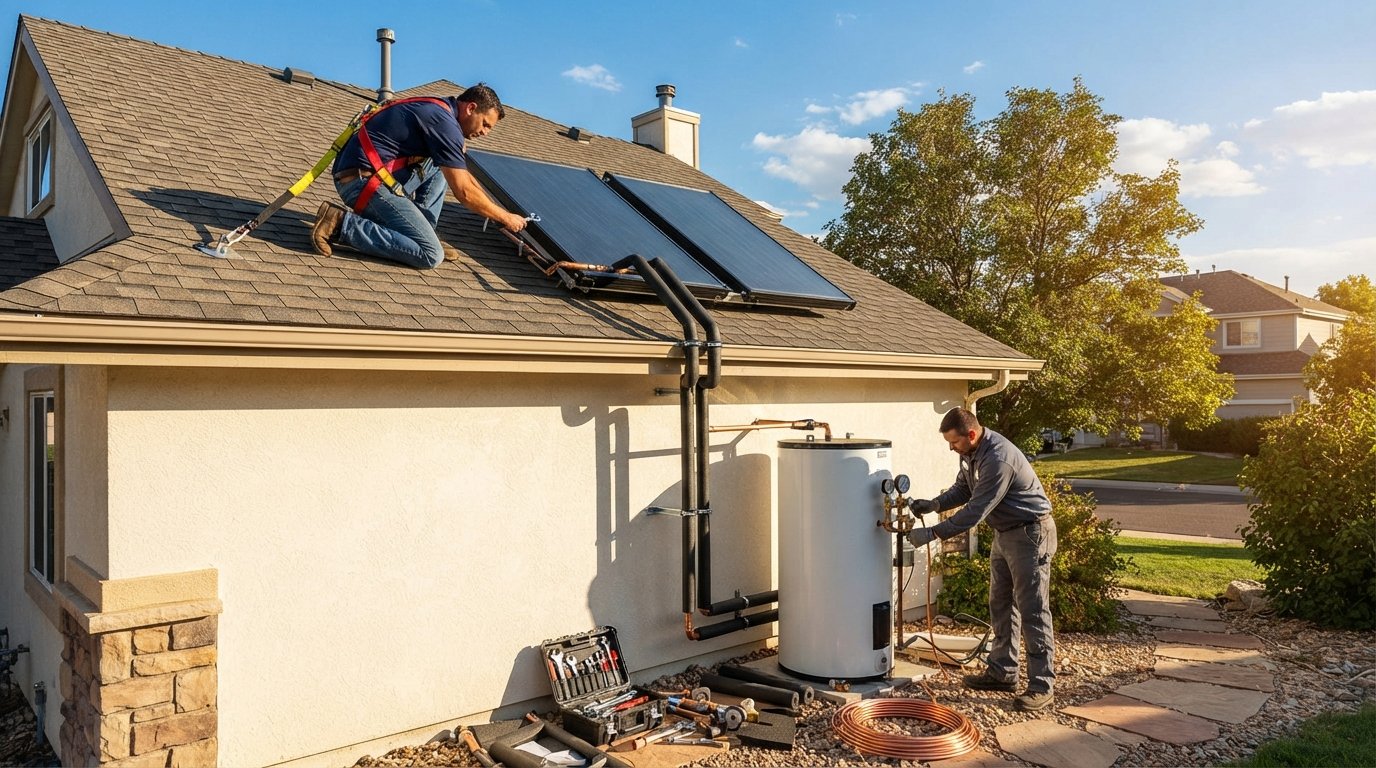
A solar water heating system is built around three core components that work together: solar collectors, a storage tank, and a backup heating source. The collectors absorb sunlight and convert it into heat. That heat is transferred to a fluid, either water or an antifreeze mixture, which circulates through the system. The heated fluid then passes through a heat exchanger or flows directly into a well-insulated storage tank, where hot water waits until you need it. Because sunshine is not constant, every practical system includes a backup element, usually an electric resistance element or a gas-fired booster, that kicks in during cloudy stretches or periods of unusually high demand.
There are two main families of systems, and the distinction matters for both performance and price. Active systems use pumps and controllers to move fluid through the collectors. They are more efficient and more common in colder climates, but they cost more and depend on electricity for pumping. Passive systems rely on gravity and natural convection, with no pumps or controllers. They are simpler, cheaper, and more durable, but they are generally less efficient and work best in mild climates. Within those families, you will encounter flat-plate collectors, evacuated-tube collectors, and integral collector-storage units, each with its own strengths.
The overall workflow is straightforward once you see it laid out. The steps below describe how a typical active closed-loop system operates through the day:
- Sunlight strikes the roof-mounted collectors, heating the transfer fluid inside.
- A controller senses that the collector is hotter than the storage tank and turns on the pump.
- Heated fluid circulates to a heat exchanger, warming potable water in the storage tank.
- When the tank reaches its set temperature, the controller shuts the pump off to avoid heat loss.
- If tank temperature drops below a threshold (overnight or during cloudy weather), the backup heater maintains hot water.
That last step is the part homeowners often overlook. A solar water heating system is not a stand-alone replacement for your existing water heater in most cases; it is a pre-heater that reduces how hard your conventional heater has to work. In sunny regions, a well-sized system can supply 60 to 80 percent of annual hot water demand. In cloudier or colder regions, expect that figure to land closer to 40 to 60 percent. Understanding this ratio is essential before you evaluate quotes, because it determines the real payback math.
Solar Water Heating System Cost: What Homeowners Actually Pay
Solar water heating system cost varies widely based on system type, size, climate, and local labor rates, but the national picture is reasonably consistent. Most residential installations fall between $3,000 and $8,000 before incentives, with the national average landing somewhere around $5,000 to $6,000 for a complete active closed-loop system with a 60 to 80 gallon solar storage tank. Passive systems sit at the low end, often $2,000 to $4,000 installed, while high-performance evacuated-tube systems with larger tanks can exceed $9,000. These figures typically assume you are adding solar as a pre-heat system alongside an existing water heater rather than replacing the entire hot water setup.
Several variables push the number up or down. Collector type is the biggest driver: flat-plate collectors are moderately priced and widely available, while evacuated tubes cost more but perform better in cold, cloudy conditions. Tank size and whether you need a new tank or can reuse an existing one matters as well. Roof complexity, pipe runs, and whether your home needs structural reinforcement for roof-mounted collectors all add labor. If you are also considering broader heating upgrades, our guide on heating system repair explains how conventional systems fail and when repair versus replacement makes sense, which is useful context when weighing solar thermal against a full HVAC overhaul.
Incentives change the effective cost dramatically. The federal residential solar tax credit (currently 30 percent for qualifying solar water heating property through 2032) applies to the installed cost of the system, and some states, utilities, and local governments add rebates or property tax exemptions on top. A $6,000 system with a 30 percent federal credit nets out to about $4,200 before any state or utility incentives. That is the number to compare against a conventional storage water heater, which typically runs $1,200 to $2,500 installed and lasts 10 to 12 years, or a heat pump water heater, which runs $1,500 to $3,500 installed and cuts energy use by roughly 60 percent compared with a standard electric tank.
Payback Period and Lifetime Savings
The payback question is where solar thermal either wins or loses for most homeowners. A typical family of four spends $400 to $700 per year heating water with electricity, or somewhat less with natural gas. If a solar system covers 60 percent of that demand, annual savings land around $240 to $420. Against a net installed cost of $4,000 to $4,500, simple payback runs roughly 10 to 18 years. That is a long horizon, and it is why solar thermal is rarely the slam-dunk that solar electric has become in high-electricity markets. However, systems often last 20 to 30 years, so the later years of operation are essentially free hot water, and savings compound if utility rates rise.
There is also a maintenance cost that belongs in the math. Active systems need periodic checks, pump replacement every 10 to 15 years, and antifreeze changes in closed-loop systems. Budget $100 to $250 per year for routine service, more if you neglect it. The financial case improves substantially in sunny states with high electricity rates, such as Hawaii, California, Arizona, and Florida, where payback can drop to 6 to 10 years. It weakens in cloudy northern markets with cheap natural gas, where a heat pump water heater or a high-efficiency tankless unit often delivers a faster return.
Climate, Roof Orientation, and Site Suitability
Whether solar thermal is right for your home depends heavily on where you live and how your roof is positioned. Collectors perform best on a south-facing roof with a tilt roughly equal to your latitude, receiving direct sun for at least five to six hours per day. East and west orientations can work with a modest efficiency penalty, but north-facing roofs are generally poor candidates. Shading is equally important: a mature tree that shades the collector area for part of the day can wipe out a large share of the system's output, and trimming or removing trees adds cost and complexity.
Climate determines which system type makes sense. In mild climates like Florida, Texas, and the Southwest, passive and drain-back systems work well and freeze protection is simple. In colder regions, closed-loop systems with antifreeze are the standard because they avoid freeze damage, and evacuated-tube collectors hold up better in low-light winter conditions. Homeowners in areas with hard freezes should insist on a closed-loop design or a drain-back system that empties the collectors when temperatures drop. Roof condition matters too: if your roof is nearing the end of its life, install the solar system after reroofing, not before, to avoid paying for removal and reinstallation later.
Maintenance, Freeze Protection, and System Lifespan
Solar water heating systems are low-maintenance but not maintenance-free. The collectors themselves are durable, with flat-plate units typically lasting 20 to 25 years and evacuated tubes 15 to 20 years. Tanks usually last 10 to 15 years, similar to conventional water heaters, and pumps and controllers have shorter service lives of 10 to 15 years. A simple annual inspection, checking for leaks, verifying controller operation, and confirming that the antifreeze mixture is at the right concentration, catches most problems early.
Freeze protection deserves special attention because a frozen collector loop can crack pipes and cause expensive water damage. Closed-loop systems use a propylene glycol mixture that lowers the freezing point, but the mixture degrades over time and needs testing every few years. Drain-back systems take a different approach, pumping the water out of the collectors whenever the pump stops, which eliminates freeze risk entirely but requires a tank large enough to hold the drained fluid. In either case, ask your installer to explain the freeze strategy in plain language and to show you where the valves and controller are, so you can monitor the system yourself between service visits.
When a Tankless or Heat Pump Water Heater Is the Better Fit
Solar thermal is not the only path to lower water heating bills, and for many homes it is not the best one. If your roof is shaded, north-facing, or structurally unsuited to collectors, a heat pump water heater is often the smarter investment. These units pull heat from the surrounding air and use it to warm water, cutting electricity use by about 60 percent compared with a standard electric tank. Installed cost runs $1,500 to $3,500 before incentives, and payback is often three to six years, far faster than solar thermal in most markets. They do need space and a somewhat warmer location, such as a garage or basement, to perform well.
Tankless water heaters are another option, though their economics are different. They cost $1,000 to $3,000 installed and never run out of hot water, but they are usually gas-fired and their energy savings are modest, typically 8 to 34 percent compared with a storage tank depending on usage. They shine in households with high simultaneous demand or limited space, not necessarily as an energy-saving play. If you are weighing a broader system upgrade, it helps to work with vetted local professionals who can assess your roof, electrical panel, and plumbing in one visit. Platforms like Repairmen connect homeowners with licensed contractors across plumbing, electrical, HVAC, and remodeling categories, which is useful when you want multiple opinions on whether solar thermal, a heat pump, or a conventional replacement is the right call for your house.
The practical rule of thumb is this: solar thermal wins when you have strong sun exposure, high water heating costs, available incentives, and a roof that will not need replacement soon. A heat pump water heater wins when roof conditions are marginal, upfront budget is tight, or you want the fastest payback. Many homeowners in sunny states combine the two, using solar thermal as a pre-heater and a heat pump as the backup, which delivers the lowest long-term operating cost but the highest upfront investment.
Getting Quotes and Avoiding Costly Mistakes
Because solar water heating system cost and how it works vary so much by region, the only reliable number is a site-specific quote. Before you request one, gather a few basics: your average monthly water heating cost, the age and condition of your roof, your roof's orientation and shading, and whether your current water heater is electric or gas. Installers will use these details to size the collectors and tank correctly. An undersized system wastes money on backup heating, while an oversized system adds cost without proportional savings.
When comparing quotes, ask each contractor to itemize collectors, tank, controller, pump, labor, permits, and any structural work separately. Confirm that the quote includes freeze protection appropriate for your climate, and ask how the system integrates with your existing water heater. Verify eligibility for the federal tax credit and any state or utility rebates, and ask the installer to document the system so you can claim them. Finally, check licensing and insurance, request references from similar homes in your area, and get at least three quotes. A well-installed solar water heating system can deliver two decades of reduced bills, but a poorly sized or poorly protected one can become an expensive source of leaks and service calls. Taking the time to compare offers carefully is the difference between a smart renewable upgrade and a costly experiment.