
Window Replacement Energy Savings: Myth Versus Reality
Window replacement energy savings myth versus reality: what you actually save, what you don't, and how to compare quotes. Call (833)-365-8755 for help.

By Alex Carter
Learn more about Window Installation for guides, costs, and what to expect.
Compare Window Installation Pros Near You

Enter your ZIP code to compare independent local professionals and request free quotes.
You have probably seen the claims: new windows can cut your energy bills by 30, 40, even 50 percent. The numbers sound impressive, and window companies repeat them with confidence. But if you are a homeowner staring at a quote for $8,000 to $15,000 or more, you deserve a straight answer about what replacement windows can and cannot do for your energy costs. The truth sits somewhere between the marketing hype and the cynical dismissal. New windows do save energy, but the amount depends heavily on your climate, your current windows, your home's insulation and air sealing, and the specific products you choose. This article separates the window replacement energy savings myth versus reality so you can plan your project with realistic expectations and compare quotes from independent local providers with confidence.
What the Energy Savings Claims Really Mean
When a salesperson tells you that new windows will slash your energy bills, they are usually citing a best-case scenario from an energy model or a manufacturer's study. Those studies often compare a single-pane window from the 1970s to a top-of-the-line double-pane model with low-E glass and argon fill. In that narrow comparison, the improvement is real and significant. But your actual savings will be lower if your home already has decent double-pane windows, if your attic is under-insulated, or if your ducts leak conditioned air into the crawlspace.
The U.S. Department of Energy estimates that windows account for roughly 25 to 30 percent of a home's heating and cooling energy use. That figure reflects all heat gain and loss through glass, frames, and air leaks around the window. Replacing old windows can reduce that portion, but it does not eliminate it. A more realistic expectation for a whole-house window replacement in an average home is a 7 to 15 percent reduction in total energy costs, with higher savings in extreme climates and older homes with single-pane windows. That is still meaningful money over time, but it is not the dramatic figure that some advertisements imply.
Part of the confusion comes from how savings are calculated. Many claims focus only on the window's insulating value and ignore the fact that windows also affect heating and cooling loads in complex ways. In a hot climate, a window with a low solar heat gain coefficient can reduce air conditioning costs, but it may also reduce passive solar heating in winter. In a cold climate, a low U-factor helps retain heat, but if the window is not properly air-sealed during installation, the benefit shrinks. The window replacement energy savings myth versus reality gap widens when installation quality is ignored.
U-Factor, SHGC, and Air Leakage: The Ratings That Matter
To evaluate any window's energy performance, you need to understand three ratings: U-factor, solar heat gain coefficient (SHGC), and air leakage. These numbers appear on the NFRC label attached to every window sold in the United States, and they are far more useful than vague promises about savings.
U-factor measures how well a window insulates. Lower is better. A single-pane window might have a U-factor of 1.0 or higher, while a high-performance double-pane window can be as low as 0.25 to 0.30. Triple-pane windows can go even lower, but the added cost rarely pays back in mild climates. SHGC measures how much solar heat passes through the glass. In hot climates, you want a low SHGC (0.25 or lower) to block heat gain. In cold climates, a higher SHGC (0.40 or above) lets winter sun warm the house. Air leakage measures how much air escapes through the window assembly itself. A rating of 0.3 cfm per square foot or lower is considered good; the best windows score below 0.1.
These ratings interact, and choosing the right combination for your climate is essential. A window with an excellent U-factor but a high SHGC will underperform in Phoenix, while a window with a low SHGC will waste passive solar potential in Minneapolis. The window replacement energy savings myth versus reality debate often ignores this climate-specific nuance. When you compare quotes from independent local providers, ask for the NFRC ratings on each product and match them to your climate zone. The DOE's Energy Star program provides climate zone recommendations that can guide your selection.
Air leakage deserves special attention because it is the most overlooked factor. Even the best window will leak if it is installed poorly or if the rough opening is not sealed correctly. Many homeowners replace windows and still feel drafts because the installer did not address gaps between the window frame and the wall. A thorough installation includes low-expansion foam, caulk, and proper flashing. If you are comparing quotes, ask each provider how they handle air sealing and whether they include it in the price.
Where Energy Loss Actually Happens in a House
Windows are a visible target, but they are not the only place where homes lose energy. In a typical house, the largest energy losses often come from the attic, walls, floors, and ductwork. The attic alone can account for 25 percent or more of heat loss in winter. Unsealed gaps around plumbing penetrations, recessed lights, and the attic hatch let warm air escape in winter and hot air enter in summer. Ducts that run through unconditioned spaces can leak 20 to 30 percent of the air they carry.
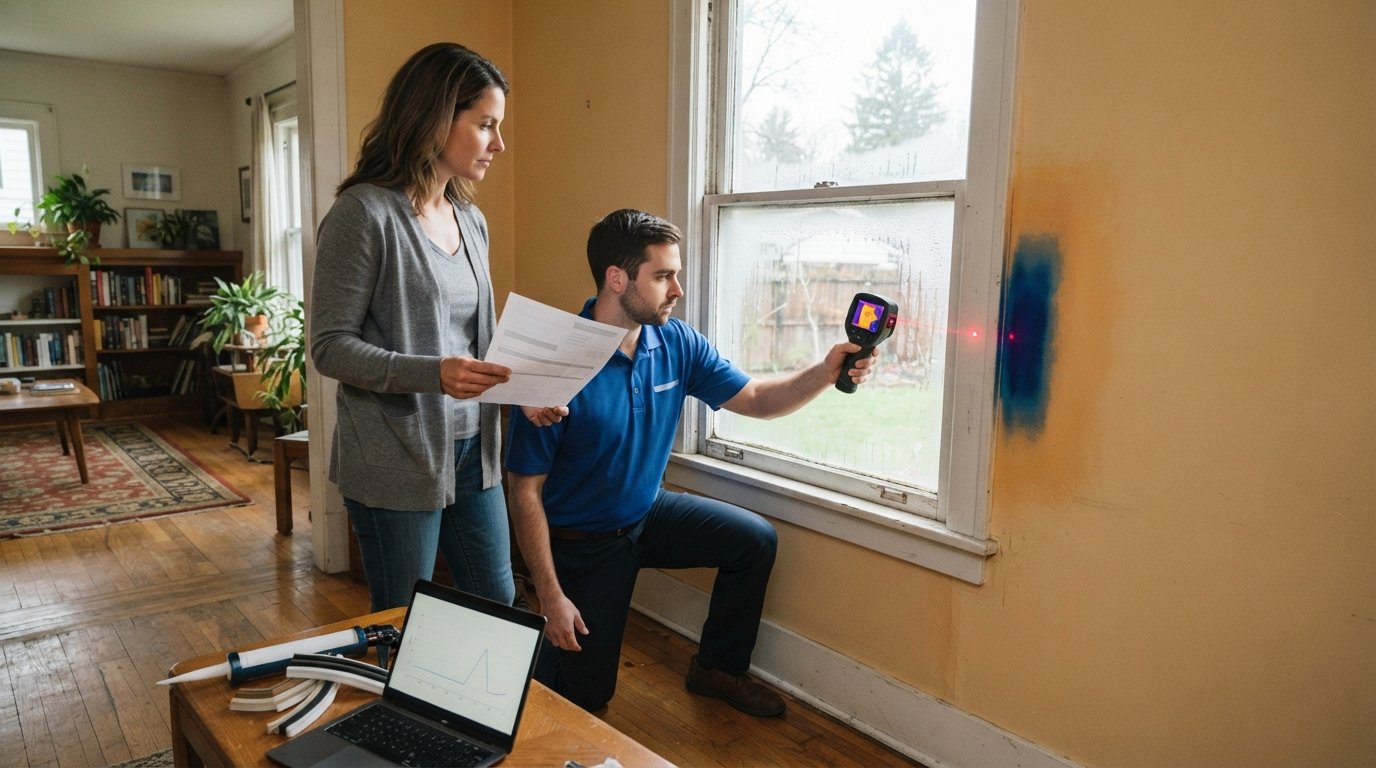
Before you invest in new windows, it helps to understand your home's overall energy profile. A home energy audit, often available through your utility or a local provider, can identify the biggest opportunities. If your attic is under-insulated and your ducts are leaky, addressing those issues first may deliver larger savings per dollar than window replacement. That does not mean windows are unimportant; it means the window replacement energy savings myth versus reality conversation should include the whole house.
Air sealing is often the cheapest and most effective first step. Caulking around exterior windows and doors, sealing gaps in the attic, and installing weatherstripping can reduce drafts and energy waste for a few hundred dollars. Insulation upgrades in the attic and walls can follow. Once those basics are handled, new windows can deliver their full benefit. If you replace windows without addressing air sealing and insulation, you may still feel drafts and see smaller bill reductions than expected.
Payback Timelines: Windows Versus Insulation and Air Sealing
Homeowners often ask how long it takes for new windows to pay for themselves. The honest answer is that the payback period for windows alone is usually long, often 15 to 25 years or more, depending on energy prices, climate, and the efficiency of the old windows. That is because windows are expensive and the annual energy savings, while real, are modest relative to the upfront cost. By contrast, attic insulation and air sealing often pay back in 3 to 7 years, and duct sealing can pay back even faster.
This does not mean window replacement is a bad investment. It means you should evaluate it as part of a broader energy upgrade plan. If your windows are old, drafty, and difficult to operate, replacement improves comfort, appearance, and functionality in ways that go beyond energy savings. The window replacement energy savings myth versus reality is that windows are rarely a pure financial play; they are a home improvement with energy benefits that vary widely.
To estimate payback for your situation, gather your annual heating and cooling costs, estimate the percentage of that cost attributable to windows (typically 25 to 30 percent), and multiply by the expected reduction (often 20 to 40 percent of window-related energy). For example, if you spend $2,000 per year on heating and cooling and windows account for 30 percent ($600), a 30 percent reduction saves $180 per year. At $10,000 for replacement, the simple payback is over 55 years. That calculation shows why windows are rarely justified on energy savings alone. However, if you are also addressing insulation and air sealing, the combined package can be more attractive.
For a deeper look at how window costs compare to their value, see our guide on window replacement cost vs value. It breaks down the financial trade-offs and helps you decide whether replacement fits your priorities.
Comfort, Noise, and Condensation: The Benefits Beyond Savings
Energy savings get the headlines, but the everyday benefits of new windows often matter more to homeowners. Comfort is the big one. Old windows, especially single-pane aluminum models, feel cold in winter and hot in summer. They create drafts and uneven temperatures near the glass. New windows with insulated frames and low-E glass reduce those discomforts, making rooms more usable and pleasant.
Noise reduction is another tangible benefit. Double-pane windows with laminated glass or dissimilar glass thicknesses can significantly reduce outside noise from traffic, neighbors, and lawn equipment. If you live near a busy street or in a noisy area, this improvement alone can justify the investment for many homeowners. Condensation is a third benefit. Old windows often sweat in winter, leading to water damage on sills and frames. New windows with warm-edge spacers and insulated frames stay warmer on the interior surface, reducing condensation and the associated moisture problems.
These comfort and livability improvements are real, and they do not show up in energy payback calculations. When you weigh the window replacement energy savings myth versus reality, include these quality-of-life factors. A quieter, more comfortable home with less condensation is valuable even if the energy savings are modest.
How to Compare Replacement Window Quotes
Comparing window quotes can feel overwhelming because providers package their offerings differently. To make an informed decision, focus on the details that affect performance and value. Start by asking for the NFRC ratings for each window model, including U-factor, SHGC, and air leakage. Confirm that the quoted price includes installation, air sealing, and disposal of old windows. Ask about the warranty terms for both the product and the labor, and get them in writing.
It also helps to compare at least three quotes from independent local providers. The free matching service at ContractorHomeQuotes can connect you with local professionals who provide no-obligation estimates, making it easier to see the range of options. When you review each quote, use a checklist to ensure you are comparing apples to apples. Here are the key items to verify:
- NFRC ratings for U-factor, SHGC, and air leakage
- Glass type (double or triple pane, low-E coating, argon or krypton fill)
- Frame material (vinyl, wood, fiberglass, aluminum) and its insulation properties
- Installation method (full-frame replacement versus pocket replacement) and air sealing details
- Warranty coverage for product and labor, including duration and exclusions
After you have the quotes, do not simply choose the lowest price. A low bid that excludes air sealing or uses low-quality windows may cost more in the long run. Look for a provider who explains the ratings, answers your questions clearly, and offers a detailed written estimate. If a quote seems vague, ask for clarification before signing. The window replacement energy savings myth versus reality gap often comes down to installation quality and product selection, so take the time to compare carefully.
Finally, consider the timing of your project. If your current windows are failing, replacement is urgent. If they are functional but inefficient, you may have time to plan a phased approach that includes insulation and air sealing first. Either way, getting multiple quotes from independent local providers is the best way to understand your options and make a confident decision.
New windows are a significant investment, and the energy savings alone rarely justify the cost in a short timeframe. But when you factor in comfort, noise reduction, condensation control, and the long-term durability of modern windows, replacement can be a worthwhile part of a broader home upgrade. By understanding the real numbers behind the window replacement energy savings myth versus reality, you can set realistic expectations and choose products and providers that deliver value for your home.