
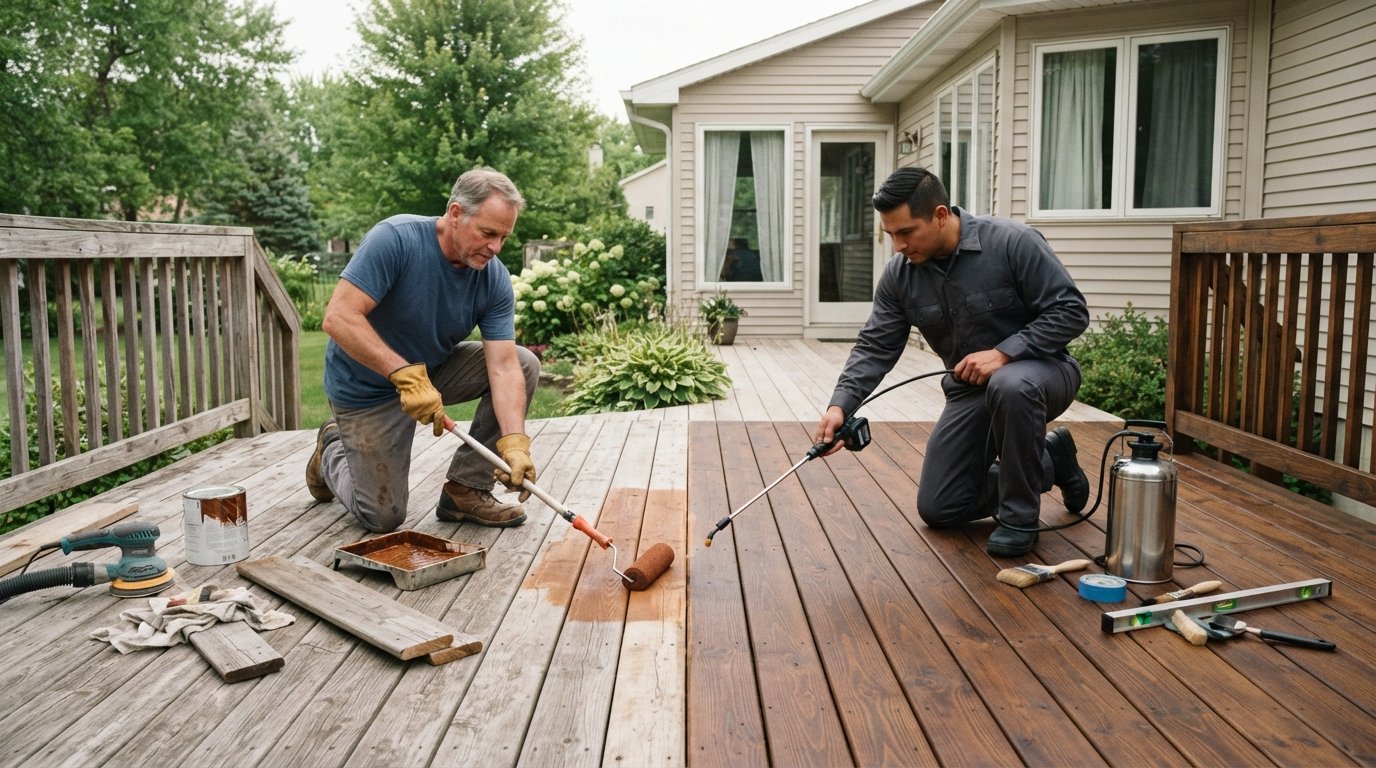
DIY Versus Professional Deck Staining and Sealing
Compare diy versus professional deck staining and sealing on prep, cost, and durability. Call (833)-365-8755 to get matched with vetted deck contractors.

By Julian Hayes
Learn more about Deck Staining and Sealing for guides, costs, and what to expect.
Compare Deck Staining and Sealing Pros Near You

Enter your ZIP code to compare top-rated local professionals and request free quotes.
A weathered deck tells a story, but it is probably not the story you want guests to read. Gray boards, splinters, and peeling finish signal neglect, and they also shorten the life of one of the most expensive exterior features on your property. Every few years, homeowners face the same crossroads: grab a roller and a weekend, or write a check and let a crew handle it. The decision between diy versus professional deck staining and sealing is not about laziness or budget alone. It is about prep quality, product knowledge, safety, and how long the results will actually last.
That choice matters more than most people realize. A deck stain applied over a dirty or damp surface can fail within a single season, wasting both money and effort. A professional job with proper prep can hold up for three to five years or more. In this guide, we break down the real differences so you can choose the path that fits your time, skills, and long-term goals.
The Prep Work That Determines How Long a Finish Lasts
Most failed deck finishes are not product failures. They are preparation failures. Dirt, mildew, tannin bleed, and mill glaze all prevent stain from bonding to wood fibers, and no amount of expensive sealer will compensate. Whether you hire out or do it yourself, prep is where the majority of labor hours go, often sixty to seventy percent of the total job.
Professional crews follow a consistent sequence that includes inspection, cleaning, stripping old finish, sanding, brightening, and moisture testing. Skipping any step invites premature peeling. A DIY approach can absolutely produce good results, but only if you replicate that sequence with the same discipline. Many homeowners underestimate how physical this phase is, especially on large or multi-level decks.
Here is the prep checklist that separates a lasting finish from a disappointing one:
- Inspect for rot, loose fasteners, and wobbly railings before any cleaning begins
- Apply a deck cleaner or stripper and scrub or pressure wash at a safe pressure (under 1,500 PSI for wood)
- Sand rough areas and any raised grain, then vacuum dust
- Apply a wood brightener to neutralize pH and open the grain
- Test moisture with a meter and wait until readings fall below 15 percent before staining
Each of those steps takes time. A typical 300-square-foot deck can consume a full weekend just on prep if you are working alone. Professionals often finish prep and staining in one to two days because they bring commercial equipment, multiple workers, and a practiced eye for what each board needs. That speed advantage is real, but it comes at a price, which is why understanding the full cost picture matters before you decide.
Product Choice by Wood Species and Sun Exposure
Walk into any home improvement store and you will see dozens of stains and sealers, each promising years of protection. The truth is that the right product depends on your wood species, the deck's orientation to the sun, and the look you want. Choosing poorly is one of the most common DIY mistakes, and it is a mistake a professional is trained to avoid.
Pressure-treated pine behaves differently from cedar or exotic hardwoods like ipe. Softwoods absorb stain unevenly and benefit from penetrating oil-based formulas that soak into the grain. Dense hardwoods often reject penetrating stains and need film-forming or specialized products. South-facing decks bake under UV rays and demand stronger pigment loads, while shaded decks stay damp longer and need mildew-resistant formulas with better breathability.
Professional contractors evaluate these factors during an on-site inspection and often recommend a specific product line or finish type. They also know how to test a small area to confirm adhesion before committing to the whole deck. For a homeowner, this knowledge is learnable, but it takes research and often a few phone calls to manufacturer technical lines. A simple rule of thumb helps: match the product to the wood, not the marketing label on the can.
One more consideration is finish type. Transparent sealers show the wood grain but offer less UV protection. Semi-transparent stains add color and moderate protection. Solid stains deliver the most UV defense but hide the grain entirely. Your choice here affects how often you will need to redo the job, which directly influences the long-term value of either approach.
Tool Rental Versus Buying for a One-Time Job
Cost is where the DIY case usually begins, and tools are a big part of that equation. If you already own a pressure washer, a pump sprayer, and quality brushes, your out-of-pocket cost for a DIY job may be limited to cleaner, brightener, and stain. If you own none of these, the math changes quickly.
Renting a pressure washer for a weekend typically runs $60 to $100, and a sprayer adds another $30 to $50. Buying these tools outright can push $400 or more, which may exceed the labor portion of a professional quote for a modest deck. For a one-time project, rental usually wins. For homeowners who plan to maintain the deck themselves for years, purchasing can pay off over time.
Professional quotes bundle equipment, labor, insurance, and disposal into one number. That number is often higher upfront, but it eliminates hidden costs like a broken sprayer, wasted stain from over-application, or a second round of product after a failed first attempt. When comparing diy versus professional deck staining and sealing, add up your true costs, including your weekend hours, before assuming DIY is cheaper.
If you decide to hire, the process of finding a qualified crew does not have to be complicated. Platforms like Contractor.Homes connect homeowners with pre-vetted local contractors and provide free quote requests, which simplifies comparison shopping for deck projects and other exterior work.
When Rot or Loose Railings Mean Hiring a Contractor
Staining and sealing is cosmetic work, but decks also have structural components that fail over time. Soft spots in the boards, wobbly railings, rusted joist hangers, and posts that move under hand pressure are signs of deeper problems. Stain will not fix these issues, and covering them up can create safety hazards and accelerate decay.
This is the clearest line between a DIY-friendly project and one that belongs in professional hands. A contractor can replace rotten boards, sister joists, reinforce railings, and bring the structure up to code before any finish is applied. That sequencing matters: staining a deck with hidden rot wastes money and delays the inevitable repair. Homeowners facing structural issues should treat staining as the final step of a repair project, not a standalone task.
Deck repair also intersects with other exterior projects. If your inspection reveals damaged siding, failing paint, or drainage problems around the deck footings, it may be worth addressing those at the same time. Our guide on DIY versus professional contractor for bathroom tile work follows a similar decision framework, and the underlying logic applies to most home improvement choices: match the task to your skills and the risk of getting it wrong.
Time, Safety, and the Real Cost of DIY
Time is the most underestimated factor in the DIY equation. A typical deck staining project takes two to four full days for a homeowner working alone, spread across prep, drying windows, and application. Professionals complete the same scope in one to two days with a crew. If your weekend time is valuable, or if weather windows are tight, that difference can be decisive.
Safety deserves equal weight. Deck staining involves ladders, chemical strippers, pressure washers, and slippery surfaces. Falls from ladders are among the most common home injury events, and chemical burns from strippers are avoidable with proper gear and experience. Professional crews carry insurance that protects you if something goes wrong on your property. DIY means you absorb that risk yourself.
There is also the question of warranty and product performance. Many stain manufacturers honor warranties only when the product is applied according to specific instructions, including moisture content and temperature ranges. A professional applicator knows these requirements and documents the job. A DIYer who applies stain in direct sun or on a windy day may void the warranty without realizing it.
Making the Decision: A Practical Framework
The right choice depends on your specific deck, not on a universal rule. A small, sound, ground-level deck with manageable prep is a reasonable DIY candidate for a confident homeowner. A large, elevated, or structurally questionable deck is a better fit for professional help. The middle ground, where most homeowners land, comes down to how much time and risk you are willing to trade for savings.
Consider these questions before you commit:
- Does the deck have rot, loose railings, or other structural issues? If yes, hire a contractor first.
- How many square feet are you finishing, and how many levels? Larger and higher decks favor professionals.
- Do you own the required tools, or will rental costs erase the savings?
- Can you commit two to four consecutive dry days to prep and application?
- Are you comfortable on ladders and with chemical strippers and pressure washers?
If you answer yes to structural problems or no to tools and time, a professional quote is likely the smarter investment. If your deck is sound, modest in size, and you have the tools and a free weekend, DIY can deliver excellent results with careful prep and the right product.
How to Get a Reliable Professional Quote
If you decide to hire, the quality of the contractor matters as much as the decision itself. Ask for proof of insurance, request references from recent deck projects, and confirm what prep steps are included in the quote. A low bid that skips stripping, sanding, or brightening is not a bargain; it is a shortcut that will cost you again in a year or two.
Get at least three quotes and compare scope, not just price. Ask each contractor which product they plan to use and why, and confirm the warranty terms in writing. A thorough contractor will inspect the deck in person, point out any repairs needed, and explain the drying timeline before scheduling the job.
For homeowners who want to streamline this process, 180 Remodel connects you with vetted local contractors and provides free, customized quotes in minutes. You can compare options side by side and choose the crew that fits your project and budget, without spending weeks making phone calls.
Whether you pick up the brush yourself or hand the job to a pro, the fundamentals do not change: thorough prep, the right product for your wood and sun exposure, and realistic timing. Get those three right, and your deck will reward you with years of dependable protection and curb appeal.
Learn more about Deck Staining and Sealing for guides, costs, and what to expect.
Compare Deck Staining and Sealing Pros Near You
Enter your ZIP code to compare top-rated local professionals and request free quotes.