
Whole House Water Filtration System Cost Benefits Explained
A whole house water filtration system cost benefits analysis: what you pay upfront, what you save on bottled water and appliances, and how fast payback arrives.

By Rachel Green
Learn more about Water Treatment System Installation or Replacement for guides, costs, and what to expect.
Compare Water Treatment System Installation or Replacement Pros Near You

Enter your ZIP code to compare top-rated local professionals and request free quotes.
If your family spends more than $30 a month on bottled water and replacement fridge filters, a whole house water filtration system could quietly pay for itself while upgrading every tap in your home. The real question is not whether clean water matters, it is whether the numbers make sense for your household. This guide breaks down the honest costs, the measurable benefits, and the payback math so you can decide with confidence.
What a Whole House Water Filtration System Actually Does
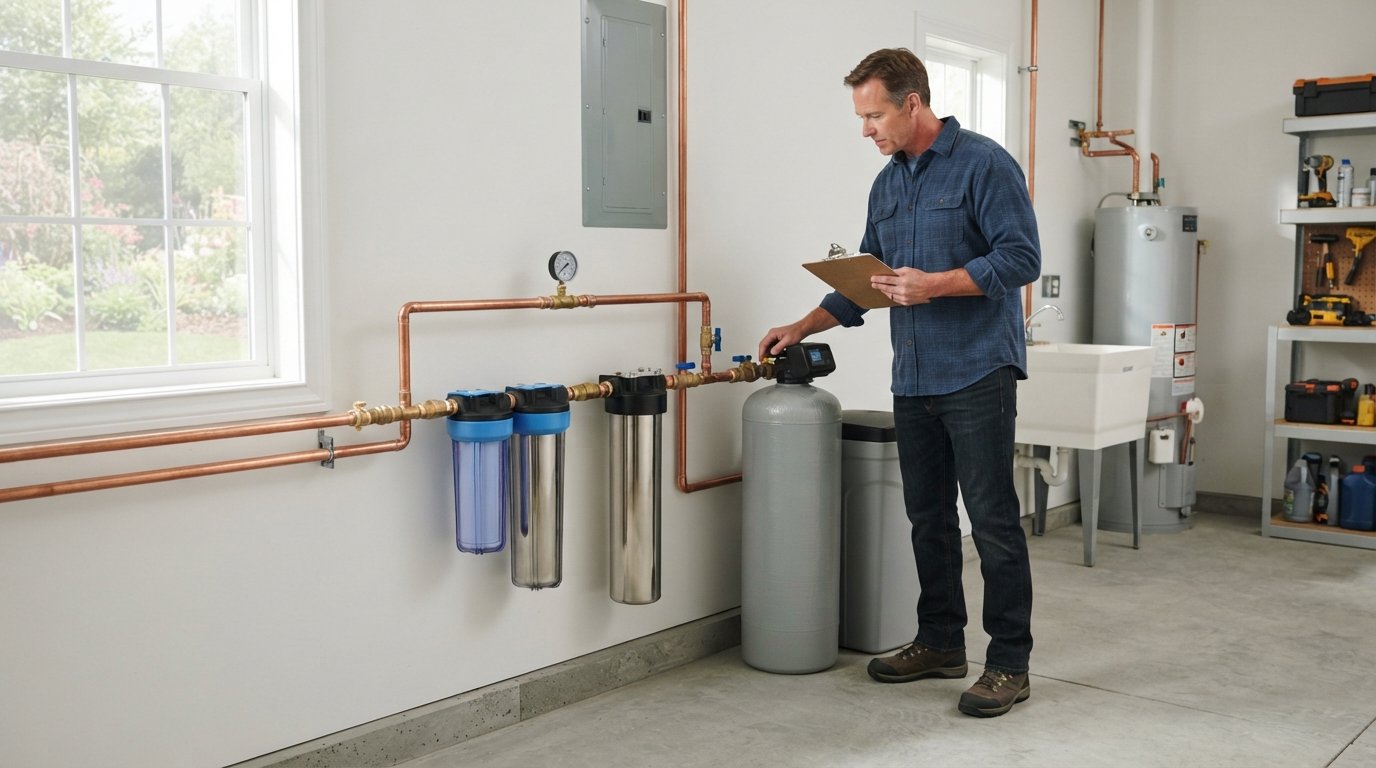
A whole house water filtration system is installed at the main water line where it enters your home. Every drop that flows to your kitchen, bathrooms, laundry room, and water heater passes through the filter first. Unlike a pitcher or an under-sink unit, it treats the entire house at once, which is why it is often called a point-of-entry system.
These systems target different problems depending on the filter media inside. Carbon-based units reduce chlorine, sediment, and odors. Specialized media can address hardness, iron, sulfur, and even some heavy metals. Many homeowners combine stages: a sediment pre-filter, a carbon block, and a water softener or conditioner working together.
The payoff shows up in places you might not expect. Cleaner water protects plumbing fixtures, extends the life of your water heater, and helps appliances like dishwashers and washing machines run more efficiently. That is where the cost benefits story begins, because the savings often come from the systems you already own.
Breaking Down the Upfront Costs
Most homeowners are surprised by how wide the price range is. A basic three-stage carbon system might cost $500 to $1,500 for the unit itself, while a high-capacity system with softening and UV treatment can run $2,500 to $6,000 or more. Installation adds another layer, typically $300 to $1,200 depending on plumbing complexity.
If you are already planning a larger renovation, bundling the install with other plumbing work can reduce labor costs. In our guide on whole house renovation services, we explain how to sequence upgrades so you are not paying twice for the same walls to be opened.
Here is a realistic cost snapshot for planning purposes:
- Basic carbon filtration: $800 to $2,000 installed
- Carbon plus water softener: $2,000 to $4,500 installed
- Premium multi-stage with UV and remineralization: $4,000 to $8,000 installed
- Annual filter replacements: $100 to $400 depending on stages and usage
Those numbers can feel steep at first glance. The key is comparing them against what you already spend on water quality, and against the repair bills that hard or contaminated water creates over time.
The Ongoing Costs Nobody Talks About
Every filtration system has recurring expenses. Filters need replacement on a schedule, usually every 6 to 12 months for carbon stages and every 3 to 5 years for media like resin or catalytic carbon. Skipping replacements is the fastest way to lose the benefits you paid for.
Electricity use is minimal for most systems, often under $30 a year. UV lamps, if included, add a small annual cost and need replacement roughly every 12 months. Water softeners consume salt, typically $100 to $200 per year for an average family.
Maintenance is the other hidden line item. Some homeowners handle filter swaps themselves in 15 minutes. Others prefer a service plan, which can add $150 to $400 annually but removes the guesswork. Either way, budgeting $150 to $500 per year for upkeep keeps the system performing as designed.
Where the Cost Benefits Come From
The financial case for a whole house water filtration system rests on several overlapping savings. No single category is huge on its own, but together they often offset the purchase price within a few years.
Start with bottled water. A family of four drinking the recommended amount spends roughly $500 to $1,500 per year on bottled water. A filtration system eliminates most of that expense after the first year. Add in the fridge filter replacements you no longer need, and the savings climb further.
Then consider appliance longevity. Hard water causes scale buildup that shortens the life of water heaters, dishwashers, and washing machines. The U.S. Department of Energy has noted that even small amounts of scale can reduce water heater efficiency. Replacing a water heater prematurely costs $1,200 to $2,500 installed, money a softener or conditioner can help you avoid.
Finally, think about plumbing repairs. Chlorine and sediment accelerate wear on seals, valves, and fixtures. Cleaner water means fewer emergency calls to a plumber and longer intervals between fixture replacements.
Health and Lifestyle Benefits That Carry Real Value
Not every benefit shows up on a receipt. Reducing chlorine exposure in showers can help people with sensitive skin or asthma. Filtering sediment and potential contaminants supports better tasting food and clearer ice. Families with young children or elderly relatives often place a premium on consistent water quality.
There is also a convenience factor that is easy to undervalue until you experience it. No more hauling cases of water from the store. No more guessing whether the tap is safe. Every sink, shower, and hose bib delivers the same treated water, which simplifies daily life in a way that is hard to price but easy to appreciate.
For homeowners planning to sell, a documented filtration system can be a subtle selling point. Buyers in areas with known water quality issues often ask about treatment, and having a system already in place removes an objection before it forms.
How to Calculate Your Personal Payback Period
Payback math is simpler than it sounds. Add up your current annual water-related spending: bottled water, fridge filters, water softener salt if you already use one, and any plumbing or appliance repairs tied to water quality. Then subtract the annual operating cost of the new system from that total. Divide the installed system cost by the annual difference, and you have your payback period in years.
For example, a family spending $900 a year on bottled water and filters, with a new system costing $2,500 installed and $250 a year to maintain, saves $650 annually. Payback arrives in under four years, and every year after that is pure savings. Factor in one avoided water heater replacement, and the timeline shortens dramatically.
If you would rather have a professional run the numbers for your specific water and home layout, the fastest path is to request multiple quotes and compare them side by side. A platform like USremodel connects homeowners with independent contractors who can assess your water, recommend the right configuration, and give you a transparent installed price.
Choosing the Right System Without Overpaying
The biggest mistake homeowners make is buying more filtration than they need. A carbon filter is plenty for chlorine and taste issues. A softener only makes sense if hardness is actually a problem. UV treatment matters mainly for well water or known microbial concerns.
Start with a water test. You can buy a basic kit for under $50 or ask a contractor to test during a quote visit. The results tell you exactly which stages to include and which to skip, which keeps both upfront and ongoing costs in check.
Then compare at least three quotes. Prices vary widely for the same equipment, and installation quality matters as much as the hardware. Look for licensed plumbers, clear warranties, and a maintenance schedule written into the proposal. When a contractor explains why each stage is included, you know you are dealing with someone who is solving your problem rather than upselling a package.
Common Mistakes That Erase the Benefits
Even a good system can underdeliver if it is installed or maintained poorly. Oversizing the unit wastes money. Undersizing it means frequent filter changes and inconsistent water quality. Bypassing the outdoor hose bibs is smart, since you do not need filtered water for the lawn, but forgetting to bypass them wastes capacity.
Another frequent error is ignoring the maintenance calendar. A clogged carbon filter stops removing contaminants and can even become a breeding ground for bacteria. Setting phone reminders for filter changes, or choosing a service plan, protects the investment you already made.
Finally, do not skip the water test after installation. A simple retest confirms the system is performing as promised and gives you a baseline for future comparisons. If readings drift, you will catch it early instead of wondering why the water tastes different six months later.
A whole house water filtration system is not an impulse buy, but it is one of the few home upgrades that improves daily life while steadily paying you back. Test your water, gather real quotes, and run the payback math for your household. When the numbers work, the decision becomes simple, and every tap in your home becomes a small daily reminder that you chose well.