
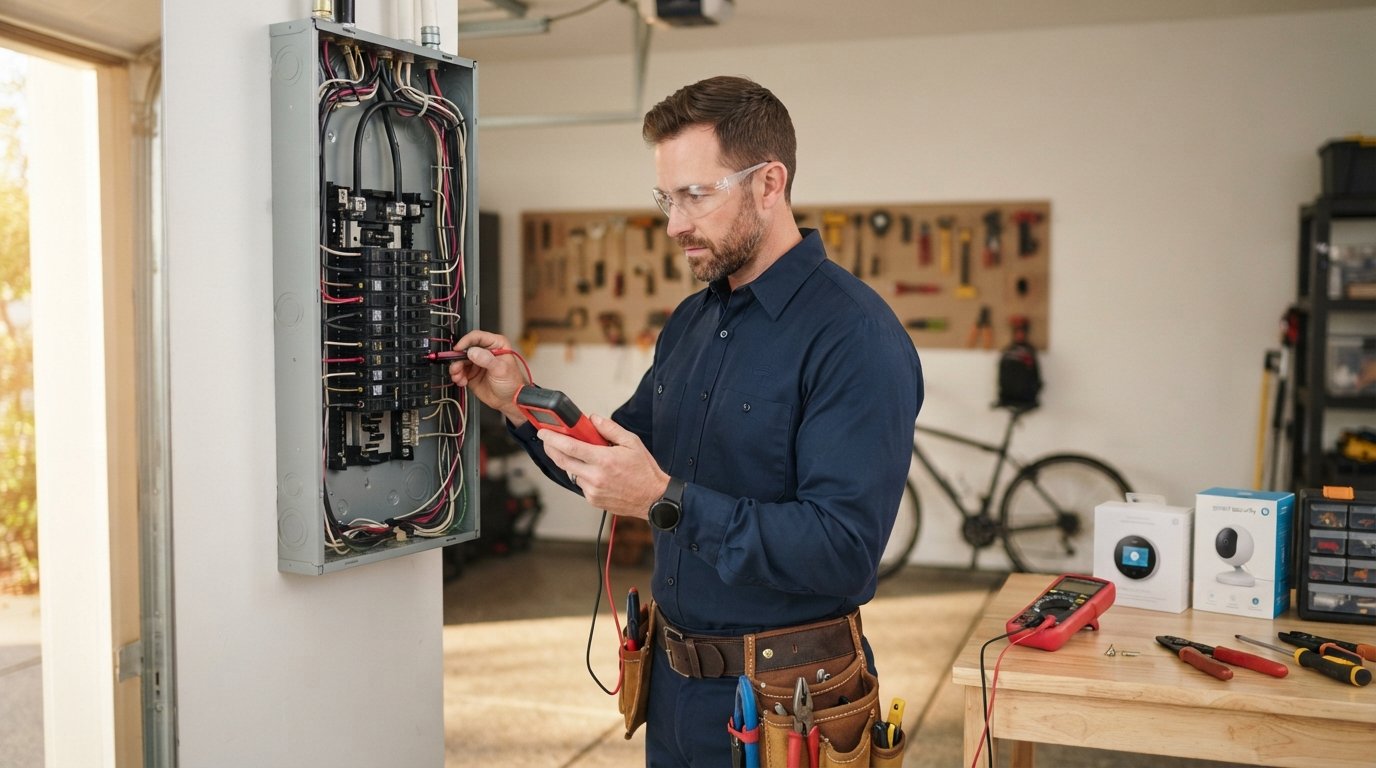
Smart Home Electrical Panel Upgrade Safety Guide
Smart home electrical panel upgrade safety starts with load planning and licensed work. Learn the warning signs and steps that protect your home and devices.

By Rachel Green
Learn more about Circuit Breaker Panel or Fuse Box Installation for guides, costs, and what to expect.
Compare Circuit Breaker Panel or Fuse Box Installation Pros Near You

Enter your ZIP code to compare top-rated local professionals and request free quotes.
A smart home is only as reliable as the electrical panel feeding it. When you add smart thermostats, security cameras, EV chargers, and whole-home automation, you are asking an older panel to carry a load it was never designed to handle. That mismatch is where real danger begins: overheated breakers, nuisance tripping, and in the worst cases, electrical fires. Understanding smart home electrical panel upgrade safety before you add one more connected device is the difference between a modern, efficient home and a hidden hazard behind the drywall.
This guide walks through what makes smart home upgrades different from ordinary electrical work, the warning signs that your panel is maxed out, the safety steps that matter most, and how to plan the project so it passes inspection the first time. Whether you are upgrading for convenience or necessity, the same principle applies: the panel is the foundation, and everything smart in your home depends on it.
Why Smart Homes Push Panels Harder Than Traditional Loads
Traditional homes drew power in predictable bursts: a refrigerator cycling, lights turning on at dusk, a dryer running for an hour. Smart homes change that pattern entirely. Many devices draw power continuously, not intermittently. A smart thermostat, video doorbell, mesh Wi-Fi system, and network-attached storage can run 24 hours a day, adding a steady baseline load that older panels were never sized to carry.
Then there is the surge problem. EV chargers, tankless water heaters, and induction ranges pull large amounts of current the moment they kick on. If those high-demand appliances share a panel with continuous smart loads, the total demand can exceed what the main breaker and branch circuits can safely deliver. The result is not always a dramatic failure. Often it is subtle: breakers that feel warm, lights that flicker when the HVAC starts, or a panel that trips during the evening when everything is running at once.
There is also the matter of age and technology. Many homes still have 100-amp panels installed decades ago, with aluminum wiring in some cases and breaker designs that predate modern arc-fault and ground-fault protection. Smart devices introduce electronics that are sensitive to voltage fluctuations, and an aging panel can deliver inconsistent power that shortens the life of expensive equipment. Upgrading the panel is not just about capacity. It is about giving modern electronics a clean, stable, and protected power source.
Warning Signs Your Panel Cannot Support More Smart Devices
Most panels do not fail without warning. They give signals, and homeowners who learn to read them can act before a small problem becomes an emergency. The challenge is that these signs are easy to dismiss as quirks rather than symptoms.
Here are the most common indicators that your electrical panel is struggling under a smart home load:
- Breakers trip repeatedly when specific appliances or chargers turn on, especially in the evening.
- The panel cover or breakers feel warm to the touch during normal use.
- Lights dim or flicker when the HVAC, EV charger, or other large load starts.
- You hear buzzing, crackling, or humming from the panel itself.
- There is a burning smell near the panel, or scorch marks on breakers or wiring.
- The panel is a 100-amp model serving a home with central air, an EV, and multiple smart systems.
Any of these signs deserves a professional evaluation, not a DIY fix. A licensed electrician can measure actual load, inspect connections, and determine whether the panel needs replacement or whether a subpanel can handle the additional circuits. Ignoring these warnings while continuing to add smart devices is the fastest way to turn a manageable upgrade into a safety emergency.
It also helps to think about the future. If you plan to add an EV charger, a heat pump water heater, or a whole-home battery system in the next few years, your current panel may already be at its limit even if it seems fine today. Planning for that growth now avoids a second upgrade later.
Core Safety Principles for Any Smart Panel Upgrade
Safety during a smart home electrical panel upgrade is not a single step. It is a set of principles that guide every decision, from the moment you choose a contractor to the final inspection. The first principle is simple: never work on a panel while it is energized. Even experienced electricians treat the main breaker as live until proven otherwise, and homeowners should never open a panel cover to "take a look." The risk of arc flash and electrocution is real and immediate.
The second principle is proper sizing. A smart home panel upgrade should be based on a load calculation, not a guess. That calculation considers square footage, major appliances, heating and cooling systems, EV charging, and the continuous draw of smart devices. A 200-amp panel is the modern baseline for most homes with significant smart technology, though larger homes or those with multiple high-demand systems may need 300 or 400 amps. Undersizing the panel to save money is a false economy that leads to nuisance tripping and premature equipment failure.
The third principle is code compliance. The National Electrical Code (NEC) sets requirements for breaker types, grounding, bonding, clearances, and labeling. A smart home upgrade must meet current code, not the code in effect when the house was built. That often means adding arc-fault circuit interrupters (AFCIs) for bedrooms and living areas, ground-fault circuit interrupters (GFCIs) for kitchens, baths, and outdoors, and surge protection at the panel to shield sensitive smart electronics. If you want to understand what a full upgrade involves beyond safety, our guide on the advantages of an electrical panel upgrade covers the performance and value side in detail.
Finally, safety means proper labeling and documentation. Every breaker should be clearly identified, and the panel should include a directory that matches the actual circuits. In a smart home, where devices may be added or moved, accurate labeling prevents future mistakes that could overload a circuit or leave equipment unprotected.
Step-by-Step Process for a Safe Smart Panel Upgrade
A safe upgrade follows a logical sequence. Skipping steps or rushing the process is where mistakes happen. The following framework reflects how professional electricians approach the job, and it is the same sequence you should expect from any contractor you hire.
- Professional load calculation and assessment. An electrician evaluates your current service, measures existing loads, and calculates the capacity needed for current and planned smart devices. This step determines whether you need a 200-amp panel or something larger.
- Permit and utility coordination. Most jurisdictions require an electrical permit for a panel upgrade. The contractor pulls the permit and coordinates with the utility to disconnect and reconnect power safely.
- Power disconnection and safe removal. The utility disconnects the service, and the electrician verifies zero voltage before removing the old panel. This is the most dangerous part of the job and should only be done by a licensed professional.
- Installation of the new panel and circuits. The new panel is mounted, grounded, and bonded according to code. Branch circuits are mapped, breakers are installed, and dedicated circuits are added for high-demand smart devices like EV chargers.
- Inspection and power restoration. A local inspector verifies the work, the utility restores power, and the electrician tests every circuit under load to confirm proper operation.
After the upgrade, take time to verify that all smart devices are functioning correctly and that no breaker is running warm. The first week is a good time to monitor for any signs of trouble. If something trips repeatedly, call the electrician back rather than resetting the breaker and hoping for the best.
It is also worth planning the layout of the new panel with future additions in mind. Leaving a few open breaker spaces costs little during installation and saves significant money later when you add a circuit for a new smart appliance or outdoor device.
Choosing the Right Professional for a Smart Panel Upgrade
The quality of the installation matters as much as the equipment. A high-end panel installed poorly is still a hazard. When evaluating contractors, look for licensed electricians with specific experience in smart home systems and modern load management. Ask whether they perform load calculations, whether they pull permits, and whether they offer a warranty on the work.
For homeowners who want to compare multiple options without spending weeks making calls, a platform like USremodel connects you with independent contractors for electrical upgrades and other renovation projects. Getting several quotes helps you understand fair pricing and find a professional who communicates clearly about safety requirements.
Do not choose a contractor based on price alone. The lowest bid often skips permits, uses undersized components, or rushes the inspection process. In electrical work, those shortcuts create risks that may not appear for months or years. A slightly higher quote from a contractor who explains the load calculation and code requirements is almost always the safer investment.
Before work begins, confirm the scope in writing: panel size, breaker types, surge protection, labeling, permit responsibility, and cleanup. A clear contract protects both you and the contractor and ensures that safety standards are not treated as optional.
Common Mistakes That Compromise Smart Panel Safety
Even homeowners who understand the importance of safety can fall into traps during a panel upgrade. One frequent mistake is adding smart devices before the panel is upgraded. If the existing panel is already near capacity, new devices increase the load and the risk. The correct order is always panel first, devices second.
Another mistake is assuming that a subpanel solves every capacity problem. Subpanels are useful for distributing circuits, but they do not increase the total service capacity. If the main service is undersized, a subpanel just moves the bottleneck. The main panel must be able to supply the total demand.
A third mistake is ignoring grounding and bonding. Smart homes rely on stable grounding for surge protection and equipment performance. Poor grounding can damage electronics and create shock hazards. The electrician should verify and upgrade grounding as part of the panel replacement, not as an afterthought.
Finally, some homeowners skip the inspection to save time or avoid a permit fee. That decision can void insurance coverage and create liability if a fire occurs. The inspection is not bureaucracy. It is the final safety check that confirms the work meets the code designed to protect your home.
Planning for Future Smart Loads
A panel upgrade is an opportunity to think ahead. The smart home of 2026 may include an EV charger, a home battery, a heat pump, and a growing number of connected devices. Each of these adds load, and each benefits from dedicated circuits and proper protection. When planning the upgrade, discuss future additions with your electrician so the panel has enough spaces and capacity to accommodate them.
Surge protection is especially important in a smart home. A single power surge can destroy thermostats, cameras, and control hubs. A whole-home surge protector installed at the panel provides a first line of defense, and it is far cheaper than replacing multiple smart devices after a storm.
Consider also the physical placement of the panel. It should remain accessible, with clear space around it, and it should be labeled clearly. In a smart home, where systems may be managed remotely, easy access to the panel is still essential for emergencies and maintenance.
Smart home electrical panel upgrade safety comes down to respecting the limits of your electrical system and planning for the load you are actually placing on it. Upgrade the panel before you add more devices, insist on licensed work and proper permits, and choose a contractor who treats safety as a requirement rather than an upsell. Do that, and your smart home can be both convenient and safe for years to come.