
Home Energy Audit Identify Savings Opportunities
A home energy audit identify savings opportunities that cut bills and boost comfort. Learn what an audit covers, how to prioritize fixes, and start saving today.

By Justin Parker
Learn more about Home Inspection for guides, costs, and what to expect.
Compare Home Inspection Pros Near You

Enter your ZIP code to compare top-rated local professionals and request free quotes.
Your monthly energy bills arrive like clockwork, yet every statement seems to nudge higher. You have replaced a few light bulbs, maybe turned down the thermostat, but the numbers barely budge. This is exactly the moment when a structured home energy audit identify savings opportunities that casual guesswork will never reveal. An audit is not a simple checklist; it is a diagnostic process that uses a combination of visual inspection, performance testing, and data analysis to uncover exactly where your home is losing energy and where you can reclaim it.
Think of your home as a system. The walls, windows, roof, insulation, air sealing, heating and cooling equipment, and even the appliances all interact. A leak here, a gap there, an underperforming furnace, and suddenly your system is working far harder than it should. A professional audit quantifies these inefficiencies, ranks them by cost and impact, and gives you a clear roadmap for upgrades. For many homeowners, the result is a 15 to 30 percent reduction in annual energy costs, often with payback periods of just a few years.
The true value of an audit goes beyond the immediate savings. It also improves comfort, reduces strain on your HVAC system, and can even prevent costly emergency repairs. This article walks you through the entire process: what an audit includes, which tools professionals use, how to prioritize the findings, and how you can get started quickly.
What a Professional Home Energy Audit Actually Covers
You might think an audit is just a quick look at your attic and a few windows. In reality, a certified energy auditor performs a series of diagnostic tests that create a complete picture of your home's performance. The process typically begins with a thorough visual inspection of the exterior and interior, looking for obvious gaps, damaged siding, cracked seals, and signs of moisture.
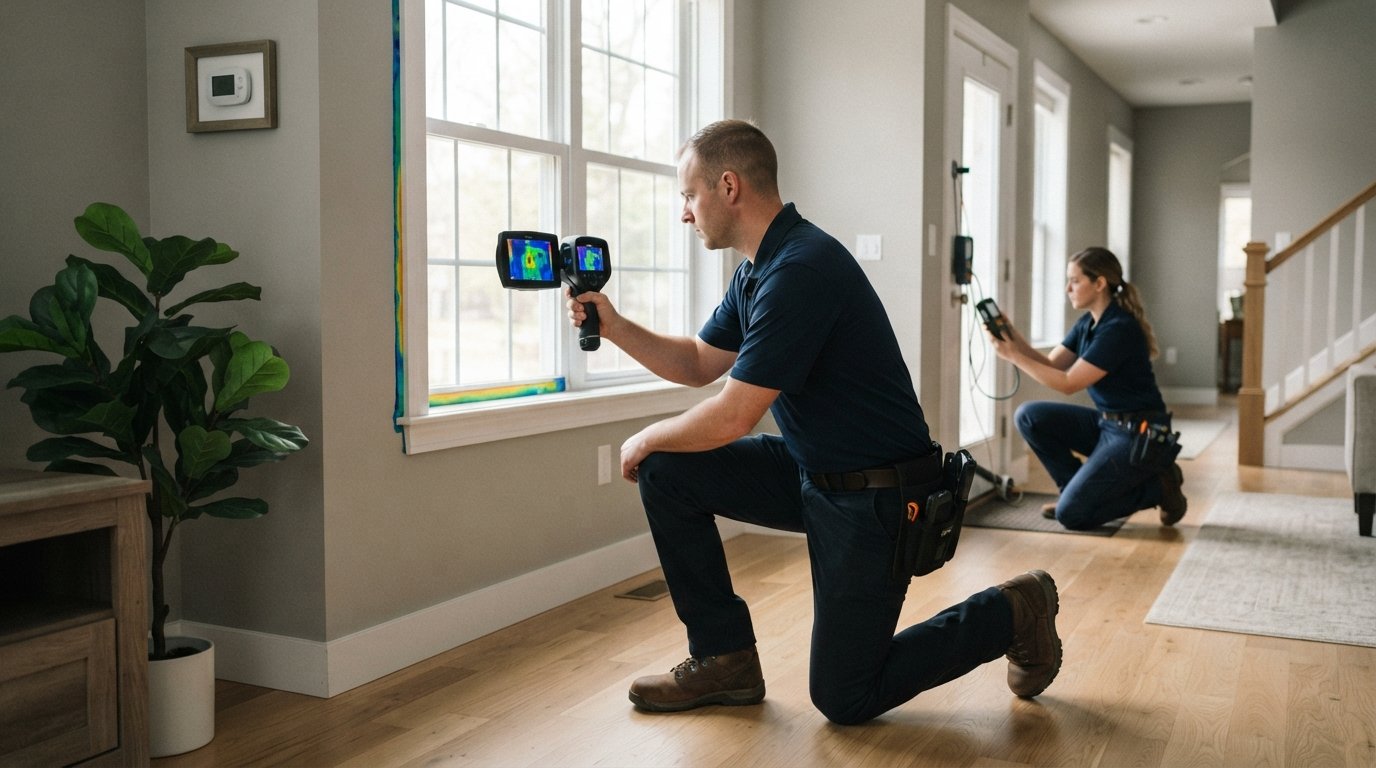
Next, the auditor uses specialized equipment to measure what cannot be seen with the naked eye. The blower door test is one of the most important. It temporarily seals a powerful fan into an exterior doorway, depressurizing the home to a standard level, and measures how much air leaks in through cracks and openings. This test can reveal hidden leaks around electrical outlets, baseboards, pipes, and recessed lighting. A thermal imaging camera, or infrared scanner, is then used to identify temperature differences in walls, ceilings, and floors, pinpointing missing insulation and thermal bridging. Finally, the auditor may inspect the HVAC system, check ductwork for leaks, and test the efficiency of the furnace or air conditioner.
To give you a clear idea of what to expect, here are the core components of a comprehensive energy audit:
- Blower door test: Quantifies the total air leakage of the home and helps locate the most significant leaks.
- Thermal imaging scan: Identifies areas of missing or damaged insulation, air infiltration, and moisture problems.
- HVAC system inspection: Checks the age, condition, and efficiency of your heating and cooling equipment, including ductwork integrity.
- Combustion safety test: Ensures that gas appliances (furnace, water heater) are venting properly and not releasing carbon monoxide into the living space.
- Lighting and appliance review: Identifies outdated equipment and suggests energy-efficient replacements, such as LEDs and ENERGY STAR appliances.
After the testing, the auditor compiles a detailed report that lists every finding, ranked by urgency and potential savings. This report becomes your personalized action plan. It tells you exactly which upgrades will give you the most benefit for your budget, whether that is air sealing, adding insulation, upgrading windows, or replacing an old boiler.
Simple DIY Checks Before You Hire a Professional
While a professional audit offers the deepest insights, you can perform several basic checks yourself to start identifying savings opportunities immediately. These tasks take an afternoon and require only common household tools. They also help you have a more informed conversation with a professional auditor or contractor.
Begin with a walk-through of your home, paying close attention to areas where different materials meet: where the foundation meets the wood frame, where siding meets brick, and around all exterior doors and windows. Hold a lit incense stick or a smoke pen near these joints. If the smoke wavers or is drawn out of the room, you have found an air leak. Common culprits include the bottom of exterior doors, mail slots, and the edges of window frames. You can often fix these with weatherstripping, caulk, or door sweeps for less than $50.
Next, inspect your insulation levels. Head to the attic with a flashlight and a tape measure. Look for the depth of insulation across the entire floor. In most climates, you want at least 12 to 14 inches of fiberglass or cellulose insulation, or an R-value of R-38 or higher. If you can see the ceiling joists, you likely need more. Also check for any gaps or thin areas, especially around attic hatches, chimneys, and bathroom exhaust fans. The insulation should be even and fully cover the floor. If you have an unfinished basement, check if the rim joists (where the foundation meets the wood framing) are insulated and sealed. This is a common area for significant heat loss.
How to Prioritize the Findings: The Energy Audit Report
When you receive the audit report, it can be tempting to try to tackle every recommendation at once. That approach is rarely wise, both for your budget and for your sanity. Instead, use the report to prioritize based on two factors: the cost of the upgrade and the potential annual savings. Most auditors will provide an estimated payback period for each measure, which is the time it takes for the energy savings to equal the upfront cost.
Typically, the highest-priority items are air sealing and insulation upgrades. These are often the most cost-effective measures, with payback periods of two to five years. Sealing leaks and adding insulation immediately reduce the workload on your HVAC system, making your home more comfortable and your bills lower. Next on the list is usually HVAC system maintenance or replacement. If your furnace or air conditioner is more than 15 years old and has a low efficiency rating (such as an AFUE below 80 percent), replacing it with a high-efficiency model (AFUE 95 percent or higher) can cut your heating costs by a third or more.
Window replacement is often the most expensive item on the list, but it is not always the first priority. If your windows are single-pane or have failed seals, they can be a major source of heat loss. However, the payback period for new windows can be 10 to 20 years. In many cases, it makes more sense to first address air sealing and insulation, and then consider window replacement as part of a larger remodel or when the windows are at the end of their lifespan. Finally, consider low-cost upgrades like installing a programmable thermostat, switching to LED lighting, and using power strips to eliminate phantom loads from electronics.
Calculating Your Potential Savings: A Realistic Look
You have likely heard the assertion that an energy audit can save you 5 to 30 percent on your energy bills. That range is wide, and the true number depends on your home's current condition and your local climate. To get a more accurate picture, you can use the audit report's estimates to calculate your annual savings potential. For example, if your annual heating and cooling costs are $2,000, a 20 percent reduction would save you $400 per year. Over ten years, that is $4,000, often with an upfront investment of only $1,500 to $2,500 for air sealing and insulation.
To make the numbers even more concrete, consider the following typical results from a professional audit on a 2,000-square-foot home in a cold climate:
- Air sealing (reducing air leakage by 25%): saves $150 to $300 per year
- Adding attic insulation to R-49: saves $100 to $250 per year
- Sealing ductwork: saves $100 to $200 per year
- Upgrading to a smart thermostat: saves $50 to $100 per year
- Replacing an old water heater with a heat pump model: saves $150 to $250 per year
These savings are not just theoretical. They compound over time, and many utilities offer rebates and incentives that can cover a significant portion of the audit cost itself. Check with your local utility company or state energy office for programs in your area. Some utilities even offer free or heavily subsidized audits for income-qualified households. The investment in an audit is often recouped within the first year through the combination of reduced energy bills and available rebates.
When to Hire a Professional vs. DIY: Making the Right Call
You have done your own walk-through and fixed the obvious drafts. Now the question is: should you hire a professional energy auditor, or continue with DIY improvements? The answer depends on your home's age, your comfort with home improvement projects, and the complexity of the issues you have found.
If your home is newer (less than 20 years old) and you have already sealed the visible gaps, you might be able to handle simple upgrades like adding weatherstripping, installing a programmable thermostat, and switching to LED bulbs. These are low-risk, low-cost projects that any homeowner can complete in a weekend. However, if your home is older, you experience drafts even after basic caulking, or you have rooms that are always too hot or too cold, a professional audit is worth the investment. The blower door test and thermal imaging will reveal hidden problems that you simply cannot find with a visual inspection alone.
Another reason to hire a professional is safety. Combustion appliances like gas furnaces and water heaters can produce carbon monoxide if they are not venting correctly. A professional auditor will test for this and also check that your gas pressure is correct. They can also identify electrical hazards, like overloaded circuits or faulty wiring, that a DIY inspection might miss. Given the potential risks, the cost of an audit (usually $300 to $600, depending on the size of your home and your location) is a small price for peace of mind.
Once you have your audit report, you can decide which upgrades to tackle yourself and which to hire a contractor for. For example, air sealing in the attic and basement is often a DIY-friendly project, but adding insulation to walls or replacing windows is best left to professionals. If you are planning a larger renovation, such as a kitchen or bathroom remodel, that is an ideal time to integrate energy efficiency upgrades like better insulation, energy-efficient windows, and a high-efficiency HVAC system. A platform like USremodel can connect you with vetted contractors who specialize in these types of projects, helping you get competitive quotes and ensure the work is done correctly.
Financing Your Energy Upgrades: Rebates, Incentives, and More
One of the biggest barriers to energy efficiency is the upfront cost. Even though the long-term savings are clear, a $5,000 insulation job might feel out of reach. Fortunately, there are several financing options and incentives that can make these upgrades more affordable. The first step is to research federal, state, and local programs. The Inflation Reduction Act, for example, offers tax credits for energy-efficient home improvements, including up to $1,200 per year for insulation, air sealing, and efficient heating and cooling equipment, and up to $2,000 for heat pumps. Many states and utilities also offer their own rebates, which can be stacked with federal credits.
For larger projects, you might consider a home equity loan, a personal loan, or a PACE (Property Assessed Clean Energy) loan. PACE loans are repaid through your property taxes, which can be a flexible option because the payments are spread out over many years. Some contractors also offer financing plans, allowing you to pay for the upgrade over time, often with zero interest for a promotional period. Before you commit, always compare the total cost of financing, including interest, against the projected energy savings. In most cases, the monthly savings on your utility bill will exceed the loan payment, making the upgrade cash-flow positive from day one.
Beyond the Audit: Long-Term Energy Habits
The audit gives you a snapshot of your home's efficiency, but your habits have just as much impact on your bills. After you have implemented the recommended upgrades, continue to practice good energy stewardship. Set your thermostat to 68 degrees Fahrenheit in the winter and 78 in the summer, and program it to adjust when you are away or asleep. Use ceiling fans to circulate air, but turn them off when you leave the room. Run full loads in the dishwasher and washing machine, and use the cold water setting for laundry. Close blinds and curtains during the hottest part of the day in summer, and open them on sunny winter days to let in free solar heat.
Regular maintenance is also critical. Change your HVAC filters every one to three months, have your system professionally serviced annually, and keep the outdoor condenser unit clear of debris. These small actions ensure that your equipment runs at peak efficiency, preventing premature wear and expensive repairs. By combining the structural improvements from your audit with these daily habits, you will maximize your savings and enjoy a more comfortable, energy-efficient home for years to come.
An energy audit is not a one-time event; it is the starting point for a smarter, more cost-effective relationship with your home. Whether you start with a DIY inspection or go straight to a professional audit, the goal is the same: to identify savings opportunities and take action. The process might seem involved, but the rewards are substantial: lower bills, a more comfortable living space, and a lighter environmental footprint. Begin with the steps outlined here, and you will be well on your way to a more efficient home.