
Foundation Crack Evaluation and Repair Options for Homeowners
Foundation cracks need accurate evaluation before repair. Call (833)-365-8755 to compare local repair options and protect your home.

By Rachel Green
Learn more about Foundation Repair for guides, costs, and what to expect.
Compare Foundation Repair Pros Near You

Enter your ZIP code to compare top-rated local professionals and request free quotes.
A crack in your foundation can trigger immediate alarm, and for good reason. The foundation supports everything above it, so any sign of movement or separation deserves attention. The good news is that not every crack signals a catastrophic failure. Some are cosmetic hairline fractures caused by normal concrete curing, while others point to serious structural or moisture problems that will only worsen with time. Understanding how to tell the difference, and knowing which foundation crack evaluation and repair options actually solve the underlying cause, can save you thousands of dollars and a great deal of stress.
This guide walks through the full picture: what causes cracks, how professionals evaluate them, the repair methods available, and how to choose the right path for your home. Whether you are staring at a thin line in your basement wall or a widening gap above a door frame, the goal is the same: diagnose accurately, repair appropriately, and prevent recurrence.
Why Foundation Cracks Happen in the First Place
Concrete is strong in compression but weak in tension. When soil shifts, moisture levels change, or the ground beneath a home settles unevenly, the foundation flexes. If that movement exceeds the concrete's tolerance, it cracks. Understanding the root cause is the first step in any meaningful evaluation, because repairing a crack without addressing its driver is like patching a tire that still has a nail in it.
Soil movement is the most common culprit. Expansive clay soils, common in Texas and parts of the Midwest, swell when wet and shrink when dry. This cycle pushes and pulls on foundation walls season after season. In colder regions, freeze-thaw cycles do similar damage. Poor drainage makes everything worse: water pooling near the foundation saturates the soil, increases hydrostatic pressure, and can erode supporting soil over time.
Other causes include inadequate compaction during original construction, tree roots drawing moisture from beneath the footing, plumbing leaks that soften the soil, and simple aging of concrete. Sometimes the crack is a symptom of a home system failure rather than a foundation defect. For example, a slab leak can undermine the soil beneath a post-tension slab and cause differential movement. In our guide on hot water problems and repair, we explain how hidden leaks can damage surrounding structures, and foundation issues are a frequent downstream consequence.
How to Evaluate a Foundation Crack: A Step-by-Step Framework
Evaluation is about gathering evidence. A single crack tells you very little on its own. What matters is its width, direction, location, whether it is active or dormant, and what other symptoms accompany it. Homeowners can perform a preliminary assessment, but a licensed structural engineer or foundation specialist should confirm any findings before you commit to a repair strategy.
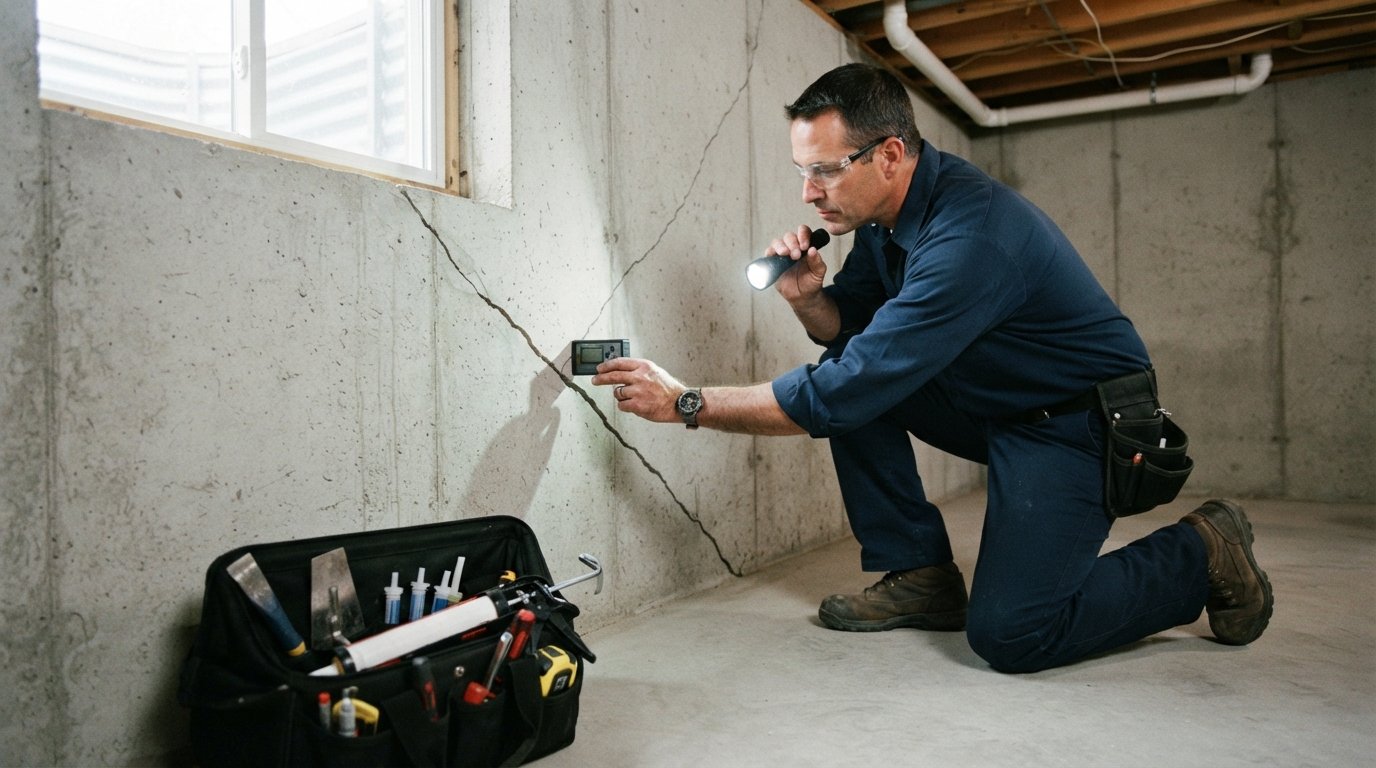
Start by documenting the crack. Measure its width at several points, note whether it is horizontal, vertical, or diagonal, and photograph it with a ruler or coin for scale. Check back monthly to see if it is growing. A crack that stays the same width for a year is likely dormant; one that widens by a millimeter or more per season is active and needs immediate professional attention.
Then look at the broader context. Are doors and windows sticking? Are floors sloping or bouncy? Is there a musty smell in the basement? Do you see efflorescence (white mineral deposits) or actual water seepage? These clues help determine whether the crack is structural, moisture-related, or purely cosmetic. The following checklist covers the key indicators professionals use during an evaluation:
- Width: Hairline cracks under 1/16 inch are often cosmetic. Cracks wider than 1/8 inch, especially horizontal ones, warrant immediate review.
- Direction: Vertical cracks are typically shrinkage-related. Horizontal cracks indicate lateral pressure, often from soil or water. Diagonal cracks suggest differential settlement.
- Location: Cracks near corners, mid-wall, or where the foundation meets the slab are more concerning than those in the middle of a large flat wall.
- Activity: Use a crack monitor or pencil marks to track movement over 3 to 6 months. Any growth is a red flag.
- Accompanying symptoms: Sticking doors, uneven floors, and visible water intrusion all raise the severity level.
Once you have this information, a professional evaluation typically includes a visual inspection, moisture readings, and sometimes a soil analysis or elevation survey. In some cases, the engineer may recommend monitoring the crack for several months before recommending a repair, especially if the cause is seasonal soil movement. The goal is to avoid unnecessary work while ensuring that genuine structural issues are addressed before they compromise the home.
Repair Options: Matching the Method to the Problem
Foundation crack repair is not one-size-fits-all. The right method depends on the crack type, the cause, and whether the goal is to stop water infiltration, restore structural integrity, or both. Below are the most common repair options, along with guidance on when each is appropriate.
1. Epoxy Injection for Structural Cracks
Epoxy injection is the go-to solution for non-moving structural cracks in poured concrete walls. The process involves injecting a high-strength epoxy resin into the crack under pressure. Once cured, the epoxy bonds the concrete back together, often stronger than the original material. This method is ideal for vertical cracks wider than 1/8 inch that are not actively leaking water. It does not address the cause of the crack, so it is best used when the movement has stabilized.
Epoxy injection is not suitable for cracks that are still moving or for cracks in block foundations, where the mortar joints and hollow cores make injection unreliable. It also will not stop water infiltration if the crack is a active leak path; in those cases, polyurethane injection is a better choice.
2. Polyurethane Injection for Leaking Cracks
When water is seeping through a foundation crack, polyurethane injection is the preferred repair. The resin expands on contact with water, filling the crack and creating a flexible, waterproof seal. Unlike epoxy, polyurethane remains slightly flexible, allowing it to accommodate minor movement without re-cracking. This makes it a good option for cracks that are not structurally significant but are allowing water into a basement or crawl space.
Polyurethane injection is typically a one-day repair. The technician drills small ports along the crack, injects the resin, and then patches the surface. It is effective for both poured concrete and block walls, though block walls may require additional measures to address water entering through the hollow cores.
3. Carbon Fiber Straps and Wall Reinforcement
For horizontal cracks caused by lateral soil pressure, carbon fiber straps or wall anchors are often the best solution. These repairs do not fill the crack itself; instead, they reinforce the wall to prevent further inward movement. Carbon fiber straps are applied vertically along the wall and are epoxied in place. They are strong, corrosion-resistant, and relatively unobtrusive.
Wall anchors are another option. They consist of a plate on the interior wall connected by a rod to an anchor in stable soil outside. By tightening the rod, the wall is pulled back toward its original position over time. This method is more invasive and expensive than carbon fiber but can correct significant bowing.
4. Slabjacking and Mudjacking
If the crack is in a slab foundation and the cause is soil settlement, slabjacking (also called mudjacking) can lift the slab back to level. A cement slurry is pumped through small holes drilled in the slab, filling voids and raising the concrete. This is a cost-effective alternative to replacing the entire slab, though it is not a permanent fix if the soil continues to move.
Polyurethane foam injection is a newer variation that uses expanding foam instead of cement slurry. It is lighter, cures faster, and can be more precisely controlled, but it is also more expensive. Both methods address the symptom (uneven slab) rather than the root cause (soil movement), so they are often combined with drainage improvements or soil stabilization.
5. Drainage and Water Management
Sometimes the best repair is not a repair at all but a correction of the water management around the foundation. If cracks are caused by hydrostatic pressure from saturated soil, fixing gutters, extending downspouts, regrading the yard, and installing a French drain or sump pump can reduce the pressure and prevent new cracks from forming. This is often a necessary complement to any structural repair.
Interior drainage systems, such as a perimeter drain leading to a sump pit, can also manage water that reaches the foundation. While these systems do not repair existing cracks, they prevent the cycle of water intrusion that drives further deterioration.
When to Call a Professional (and How to Choose One)
Any crack wider than 1/8 inch, any horizontal crack, and any crack accompanied by structural symptoms like sloping floors or sticking doors should be evaluated by a licensed professional. A structural engineer can provide an unbiased assessment and recommend a repair strategy. Foundation repair contractors can then execute the work. In some cases, you may need both: an engineer to design the repair and a contractor to implement it.
When selecting a contractor, ask for proof of licensing and insurance, request references from similar projects, and get multiple quotes. Be wary of any contractor who recommends a full foundation replacement without a thorough evaluation or who pressures you to sign immediately. A good contractor will explain the cause of the crack, the expected outcome of the repair, and any limitations of the method.
For homeowners who want to streamline the process of finding qualified professionals, platforms like USremodel connect you with a network of independent contractors for foundation repair and other home improvement projects. This can be especially helpful if you are new to the area or unsure where to start. The platform allows you to submit your project details and receive quotes from multiple vetted contractors, saving time and reducing the risk of hiring an unqualified provider.
Preventing Future Foundation Cracks
Prevention is always cheaper than repair. Once you have addressed existing cracks, take steps to stabilize the soil and manage moisture around your home. Keep gutters clean and ensure downspouts discharge at least 5 to 10 feet away from the foundation. Maintain a positive slope away from the house so water drains away rather than pooling. In drought-prone areas, consider soaker hoses or a drip irrigation system around the perimeter to keep the soil from shrinking excessively.
Also monitor your plumbing for leaks. A slow leak under a slab can cause significant soil movement over time. If you notice unexplained increases in your water bill or warm spots on the floor, investigate promptly. Regular home maintenance, including annual inspections of the foundation and crawl space, can catch small issues before they become big ones.
Finally, be cautious about planting trees or large shrubs too close to the foundation. Roots can draw moisture from the soil and cause shrinkage, leading to settlement. A good rule of thumb is to keep large trees at least 10 to 15 feet from the foundation, depending on the species.
Making an Informed Decision
Foundation cracks are a common homeowner concern, but they are not all emergencies. The key is accurate evaluation: determine the cause, measure the severity, and choose a repair method that addresses both the crack and its driver. In many cases, a combination of structural repair and water management is the most durable solution. By understanding your options and working with qualified professionals, you can protect your home's value and avoid unnecessary expense. If you are unsure where to begin, start with a professional evaluation and use that information to guide your repair decisions with confidence.