
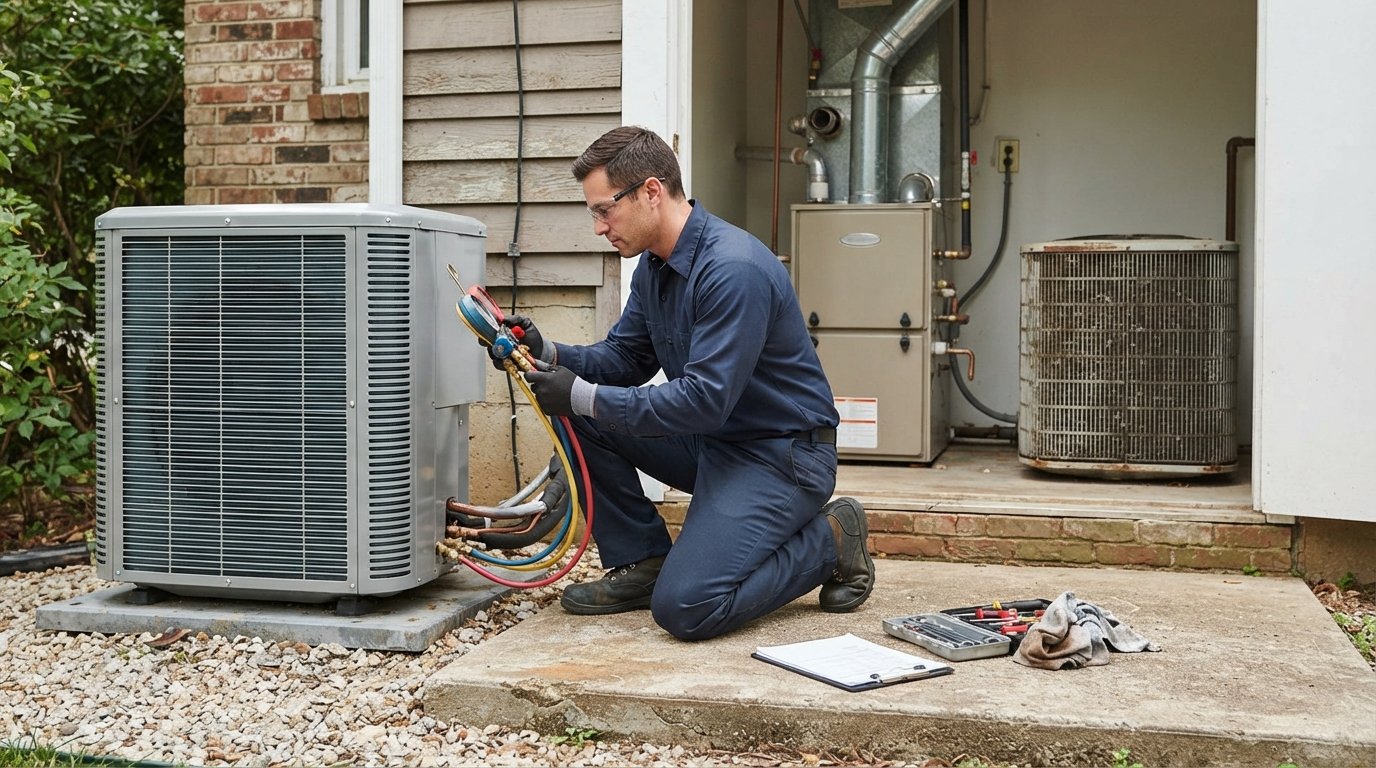
Efficiency of Air Source Heat Pumps vs Traditional HVAC
Compare the efficiency of air source heat pumps vs traditional hvac and see how moving heat instead of burning fuel can cut energy bills by 30 to 50 percent.

By Jackson Adams
Learn more about Heating System Installation or Replacement for guides, costs, and what to expect.
Compare Heating System Installation or Replacement Pros Near You

Enter your ZIP code to compare top-rated local professionals and request free quotes.
Heating and cooling a home typically accounts for more than half of total household energy use, which means the equipment sitting in your basement or utility closet has an outsized effect on your monthly bills and your carbon footprint. For decades, the default choice in most American homes has been a traditional furnace paired with a central air conditioner, a setup that burns gas or oil for heat and relies on electricity for cooling. Air source heat pumps have disrupted that pattern by moving heat instead of creating it, and the efficiency gap between these two approaches is larger than most homeowners realize. Understanding how that gap translates into real dollars, comfort, and long term reliability is the first step toward making a smart upgrade decision.
How Air Source Heat Pumps Actually Work
An air source heat pump does not generate heat through combustion. Instead, it uses a refrigerant cycle to absorb thermal energy from the outdoor air and transfer it indoors, even when outside temperatures drop well below freezing. In cooling mode, the process reverses, pulling heat out of your home and releasing it outside. Because the system moves existing heat rather than burning fuel to create new heat, it can deliver two to four units of thermal energy for every unit of electricity it consumes. That ratio is known as the coefficient of performance, or COP, and it is the single most important number in the efficiency of air source heat pumps vs traditional hvac.
A traditional gas furnace, by contrast, tops out around 98 percent annual fuel utilization efficiency in the best condensing models, and older units often run between 80 and 90 percent. A resistance electric furnace is even less efficient, converting one unit of electricity into roughly one unit of heat. When you compare those combustion based figures to the 200 to 400 percent effective efficiency of a modern heat pump, the math becomes difficult to ignore. The heat pump is not creating a miracle; it is simply exploiting physics in a way that combustion never can.
Modern cold climate heat pumps have also solved the old complaint that these systems stop working in deep winter. Inverter driven compressors and vapor injection technology allow units to maintain strong heating capacity at temperatures as low as minus 13 degrees Fahrenheit, with some models rated for continuous operation below minus 20. That means homeowners in Chicago, Minneapolis, or Boston no longer need to keep a gas furnace as a backup, although hybrid setups remain a reasonable option in the coldest pockets of the country.
Efficiency Ratings That Matter for Comparison
When you shop for HVAC equipment, you will encounter a handful of acronyms that determine how much you actually pay to heat and cool your home. For heat pumps, the two headline numbers are HSPF2 (Heating Seasonal Performance Factor) and SEER2 (Seasonal Energy Efficiency Ratio). For furnaces, the key figure is AFUE (Annual Fuel Utilization Efficiency), and for air conditioners it is SEER2 alone. Comparing these numbers side by side is the cleanest way to evaluate the efficiency of air source heat pumps vs traditional hvac before you commit to a purchase.
Here is how the ratings stack up in practical terms:
- Heat pumps: Minimum federal standards now sit around 14.3 SEER2 and 7.5 HSPF2, while premium models reach 20 or higher SEER2 and 10 or higher HSPF2.
- Central air conditioners: Entry level units start at 14.3 SEER2, and high end variable speed systems can exceed 24 SEER2.
- Gas furnaces: Standard efficiency models run at 80 percent AFUE, while condensing furnaces reach 95 to 98 percent AFUE.
- Resistance electric furnaces: Effectively 100 percent AFUE, but at a much higher cost per unit of delivered heat because electricity is priced higher than gas in most markets.
The critical takeaway is that a heat pump replaces both your furnace and your air conditioner with a single system, and its heating efficiency is measured on a different scale than a furnace. A heat pump with an HSPF2 of 9 is roughly three times more efficient at delivering heat than a 95 percent AFUE gas furnace when you account for the cost of the fuel each one consumes. That is why utilities and state rebate programs now heavily favor heat pump installations over new gas equipment.
Real World Energy Savings and Operating Costs
Efficiency ratings are useful, but homeowners want to know what shows up on the utility bill. The actual savings from switching to a heat pump depend on your climate, your current equipment, your electricity and gas rates, and how well your home is insulated. In mild and moderate climates, heat pumps routinely cut heating costs by 30 to 50 percent compared to electric resistance heat and by 10 to 30 percent compared to older gas furnaces. In colder climates, the savings are smaller but still meaningful, especially when paired with a well sealed building envelope.
Cooling performance is where heat pumps quietly shine. Because they use the same variable speed compressors and advanced refrigerant management as high end air conditioners, they often match or exceed the SEER2 ratings of standalone AC units. A homeowner replacing an aging 10 SEER air conditioner with a 17 SEER2 heat pump can expect cooling costs to drop by 30 percent or more, and they get a modern heating system in the same package. That dual purpose design is one of the most underrated arguments in the efficiency of air source heat pumps vs traditional hvac debate.
Maintenance costs also tend to favor heat pumps over the long run. There is no combustion chamber to clean, no heat exchanger to crack, and no flue to inspect. Annual tune ups are still recommended, and if something does go wrong, a professional heat pump repair service can usually diagnose and fix the issue without the safety concerns that come with gas appliances. Homeowners who want a full breakdown of repair versus replace decisions should consult a qualified technician before assuming a new system is necessary.
Installation, Rebates, and Upfront Cost Considerations
One of the persistent myths about heat pumps is that they cost far more than a traditional furnace and AC combo. In reality, the gap has narrowed considerably, and generous federal, state, and utility incentives often erase it entirely. The federal Inflation Reduction Act provides a tax credit covering 30 percent of the project cost, up to 2,000 dollars for qualifying heat pumps, and many states layer additional rebates on top. Some utilities offer another 500 to 3,000 dollars in incentives, which can bring the net cost of a heat pump installation below that of a comparable gas furnace plus air conditioner.
Installation complexity varies by home. A house that already has ductwork and an air handler can often accept a heat pump with minimal modification. Homes without ducts may need a ducted or ductless mini split configuration, which changes the scope and cost of the project. Homeowners comparing quotes should ask contractors to itemize equipment, labor, electrical upgrades, and any duct sealing work so they can see the true all in price. Platforms that connect homeowners with vetted local contractors, such as USremodel, make it easier to gather multiple quotes and compare them side by side without weeks of phone calls.
Electrical service is another factor that sometimes surprises homeowners. Older homes with 100 amp panels may need an upgrade to 200 amps to support a heat pump, especially if the homeowner is also adding an electric vehicle charger or induction range. That added cost is real, but it also improves the home's overall electrical capacity and can be rolled into a broader renovation project. A reputable contractor will flag this during the site assessment rather than after the equipment is delivered.
Comfort, Noise, and Home Value Impacts
Efficiency is not only about energy bills. Heat pumps deliver a gentler, more consistent type of heat than furnaces, which blast hot air in short cycles and then shut off. Because heat pumps run longer at lower output, they avoid the wide temperature swings that make certain rooms feel stuffy while others stay cold. That steady operation also reduces noise, and modern inverter driven outdoor units are dramatically quieter than the single stage compressors used in older air conditioners.
Indoor air quality improves as well. Heat pumps do not produce carbon monoxide, and they do not dry out the air the way a gas furnace does. Homeowners with allergies or respiratory sensitivities often notice a meaningful difference after switching. From a resale perspective, appraisers and buyers increasingly recognize heat pumps as a premium feature, particularly in markets where energy costs are high or where buyers are focused on sustainability. A documented heat pump installation can support a higher asking price and a faster sale.
It is worth noting that efficiency gains are only fully realized when the rest of the home cooperates. Leaky ducts, poor insulation, and single pane windows can waste 20 to 30 percent of the energy a heat pump produces. Homeowners planning a heat pump installation should treat air sealing and insulation as part of the same project, not an afterthought. Many utility rebate programs actually require an energy audit before they will release funds, which encourages this whole home approach.
When Traditional HVAC Still Makes Sense
Heat pumps are not the right answer for every home in every situation. In regions with very low electricity rates and abundant cheap natural gas, a high efficiency furnace paired with a modern air conditioner can still deliver competitive operating costs, at least in the short term. Homeowners who already have a relatively new furnace and are only replacing a failed air conditioner may find it more economical to stick with a standalone AC unit and defer the heat pump decision.
There are also practical constraints. Some historic districts restrict exterior equipment placement, and some older homes have ductwork that is undersized for the airflow a heat pump requires. In those cases, a ductless mini split system can solve the problem, but it changes the aesthetic and the installation scope. A qualified contractor should walk through these tradeoffs honestly rather than pushing a one size fits all solution.
That said, the long term trend is unmistakable. Federal efficiency standards, state decarbonization goals, and utility incentive programs are all tilting the playing field toward heat pumps. Homeowners who plan to stay in their homes for a decade or more will almost certainly come out ahead with a heat pump, and those who sell sooner can still capture value through lower utility bills and a more attractive listing.
Making the Decision With Confidence
The efficiency of air source heat pumps vs traditional hvac comes down to a straightforward principle: moving heat beats burning fuel. Heat pumps deliver two to four times more heating energy per unit of electricity than combustion systems deliver per unit of fuel, and they double as high efficiency air conditioners. The upfront cost gap has shrunk thanks to federal tax credits and utility rebates, and the comfort, noise, and indoor air quality benefits are tangible rather than theoretical.
Homeowners who want to move forward should start by getting an energy audit, gathering at least three detailed quotes, and confirming which incentives they qualify for before signing a contract. Working with vetted local professionals through a platform like 180 Remodel simplifies that process and helps ensure the installed system actually performs at its rated efficiency. With the right equipment and a properly sealed home, a heat pump can cut energy costs, improve comfort, and add lasting value for years to come.